
The Chemical Load We Carry: Toxins, EMFs & Hormonal Health
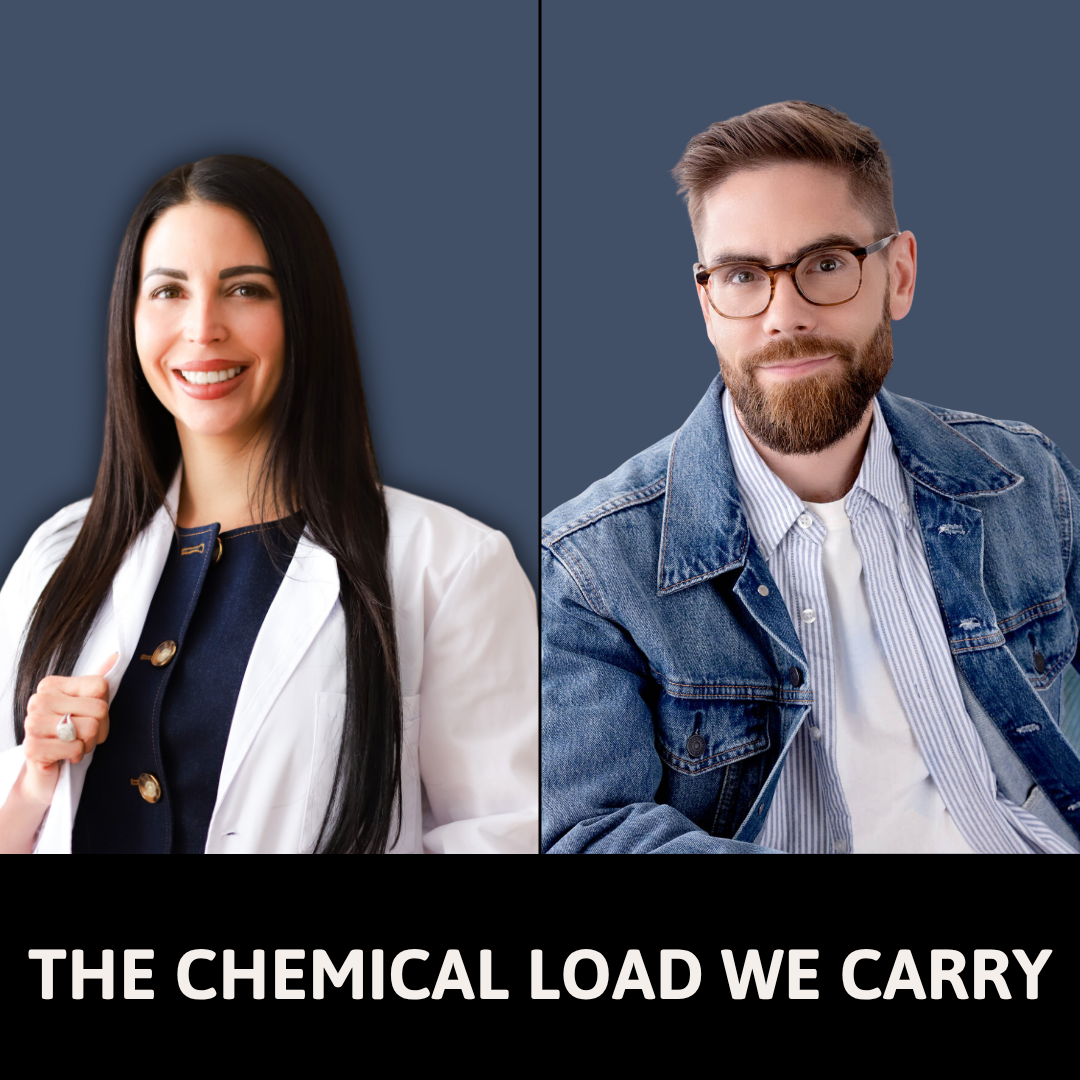
What if I told you right now, this very moment, your body is carrying a chemical load that you have never been tested for, never been warned about, and never asked for? In this episode, I’m joined by Nick Pineault, author of The Non-Tinfoil Guide to EMF and creator of the documentary Body Burden: The Toxins We Carry, to talk about what “body burden” actually means and how the chemicals we encounter through our food, water, air, plastics, household products and technology may intersect with hormones, metabolism and overall health.
We talk about how environmental medicine approaches toxic exposure, when testing may be useful, what Nick learned from discovering his own elevated lead, mercury and mycotoxin levels, and why reducing exposure may matter just as much as focusing on detoxification. We also get practical about plastics, water filtration, sleep, EMFs, sweating and elimination—and discuss why looking at the cumulative burden, rather than searching for one single toxin to blame, may be the more useful way to think about environmental health.
Topics We Cover in This Episode:
- What “body burden” actually means—and what can accumulate over time
- Why testing for specific toxins can be more complicated than it sounds
- What Nick discovered when he tested his own body burden
- Why reducing exposure comes before trying to “detox”
- How plastics and endocrine-disrupting chemicals may intersect with metabolism
- The connection Nick sees between EMFs, sleep and other environmental stressors
- Simple changes that can reduce everyday exposure
- Why environmental medicine takes a systems-based approach
If you’ve ever wondered whether the environment around you could be affecting your hormones, metabolism, sleep or energy, this conversation gives you a lot to think about without turning it into another list of things to fear.
Resources:
Find more about Nick at TheEMFGuy.com
Body Burden: The Toxins We Carry https://bodyburdenmovie.com/
Order Dr. Cassie’s Book ‘Fix Your Gut, Fix Your Hormones’: https://guthormonefix.com/
Use code LISTEN10 for 10 % off your order on shopmodernendocrine.com
Additional Resources:
Check out the website
Follow Cassie on Instagram
Follow Cassie on Facebook
Follow Cassie on YouTube
Follow Cassie on TikTok
Disclaimer:
The information presented including any materials discussed, referenced, or linked within this podcast are for general educational purposes only, not the practice of medicine.
No doctor-patient relationship is formed from you listening to this podcast or utilizing any of the information provided.
I am a doctor, but I am not talking to you as your doctor. The information provided is not intended to diagnose or treat health problems or take the place of the professional medical care provided by your doctor.
If you are experiencing any health problems, including problems you believe have been touched upon in any respect within this podcast, you should consult your doctor about the problems without delay. You may ask your doctor whether he or she believes the information I have provided would be helpful to you, but you should still consult your doctor immediately and follow his or her medical advice as your treating physician.
I’m just here to provide you with basic knowledge about the issues we discuss so you are more aware of them and can better discuss them with your doctor.
Join me on the next episode as we continue our journey.
Transcript
What if I told you right now, this very moment, your body is carrying a chemical load that you have never been tested for, never been warned about, and never asked for. Industrial chemicals stored in your tissues from decades of everyday living your food, your water, your couch, your shampoo, your takeout container. It’s called your body burden. And whether you realize it or not, you have one. And here’s where it gets personal. A lot of those chemicals are endocrine disruptors. They imitate or interfere with our hormones, our thyroid metabolism, energy. That’s not paranoia. That’s decades of published science. So today we’re asking the question almost nobody is asking out loud, what is all of this doing to us and what can we actually do about it? My guest is known as the EMF guy. His name is Nick Pinot. Like the wine. And he’s the number one best selling author of the Non Tinfoil Guide to EMF. And he’s become one of the most refreshing voices on health and technology. Equal parts humor, science, and common sense. But recently, Nick went even deeper. He produced a documentary called Body Burden The Toxins We Carry.
And in it, he follows environmental medicine physicians who have spent 40 years treating what mainstream medicine often ignored. Today, we’re talking about what’s actually stored inside all of us. What it means for your thyroid, your hormones, and your metabolism, and what the doctors who treat this for a living say actually moves the needle. And what’s just expensive urine. This isn’t fear mongering. This is the science of the chemical age. Please welcome to the show, Nick, the EMF guy. And make sure that you share this with somebody else who needs to hear it. Welcome back to the show. Today we are talking about the chemical load we’re all carrying, what it’s doing to our hormones and metabolism and what environmental medicine physicians have known about it for decades. But the scary thing is we’re not really being taught about it. Or most traditional medicines aren’t doing anything different. I have with me Nick Pino, he’s known as the EMF guy. And so he’s going to break all of this down for us. So thank you for being joining me on the podcast.
Hey, thanks for having me. It’s a pleasure.
So I know you made an amazing documentary that everyone is going to go watch after this podcast, but before we get there, tell everyone I know you started as a tech journalist, not as a health expert. I know you’re Canadian, but how did you end up becoming the EMF guy? Like, tell everyone. What surprised you most when you dug into the science and like, how you got here?
I don’t know about tech journalists. I, I’ve always been, you know, very interested in various topics. But mostly I started writing about nutrition, probably just to my mom and family at first in French here in Montreal. You know, our primary language is French. So I started writing about nutrition and all sorts of things that I didn’t know about, like, well, maybe you shouldn’t freak out as much as we thought about sodium or about saturated fats or eggs, turns out, are pretty healthy. And we’ve been eating them for like millennia and all sorts of things that I learned, you know, from pioneers such as, you know, Doctor Joseph Mercola and whatnot. And it was in 2009. But rapidly, I it’s not that I got bored with the topic, but I watched a couple of documentaries like food Inc. and all sorts of documentaries that really painted the picture of how bad our food supply is, and not just because of the quality. And before, you know, you talked about, you know, soil depletion, that’s part of it, but also the pesticides that end up on the food, but also the heavy metals that end up on the food, in the food in supplements, and then the global pollution and the pollutants that we are exposed to, to the the water, even tap water is vastly contaminated. And this is when I learned about certain things that happened next. Like Flint, Michigan had so much lead in the water. It turns out in Montreal the problem is just as bad, except we barely talk about it. So in the end, you know, at that point I was very focused on many different types of environmental toxins.
I started publishing information about that, about my findings as just a regular guy trying to make sense of it and, and really not understanding why is Health Canada not doing enough to make sure that citizens are not exposed to lead, for example, and I rapidly found out the same thing is true from the CDC, the FDA, and all the three letter agencies in the US. And it turns out in the European Union, they are way, way, way ahead, decades ahead in helping citizens avoid these environmental toxins. And around 2015, I started reading books around electromagnetic fields from Wi-Fi, Bluetooth, smartphones, cell towers and I had a very hard time believing it at first. But it turns out that the research around those is equally strong, showing that we should reduce our exposure. It is another type of environmental stressor we are exposed to, although a lot of people just say, oh, there’s no issue, everything is safe. But I just started, you know, feeling very uneasy about everyone that says that our load of toxins is, you know, it’s not a big deal. And I said, well, on what basis is it not a big deal? Right. Are we testing foods or supplements? And it turns out that testing is very bad, especially in supplements, protein powders in foods. And the more I listen to Consumer Reports and independent journalist that tested the food and found vast contamination. I said, well, I don’t think we can trust that our environment is the way it should be, which is clean. And in the end, it became very overwhelming for me to look at all of these sources of environmental toxins.
And it kind of led me two years ago to an investigation around a branch of medicine I had never heard about called environmental Medicine. It turns out 50 years ago, they started seeing mostly factory workers that were handling certain chemicals, and they could see that these workers prematurely in their 40s and 50s had things like chronic disease and dementia and, you know, symptoms that didn’t make sense for a 40 year old or for a 50 year old at the time, although nowadays it’s more common. And what they were able to do is to test patients, which was not vastly done for. Okay, what is being stored in your body? Is it PFAs? Is it certain things that you’re handling? Is it heavy metals like mercury or like lead? And what they ended up doing is also developing protocols to help people get this out of their body. So it was nothing that radical. But to this day, 50 years after these pioneers kind of started this branch of medicine, you know, I don’t see a lot of people talking about it, which is kind of why I wanted to turn my experience in a clinic of environmental medicine and kind of uncovering how poisoned I am. You know, I had no idea. But it turns out that all of us have this body burden of chemicals, and it’s impacting us more than we want to admit. And of course, it’s a scary topic, but I tend to get into scary topics and try to make it more understandable for the public and hopefully a little bit less scary because you know what to do about it.
So I love that. So EMF, some of the things we’re talking about, like Wi-Fi, Bluetooth, cell phone towers, that’s, that’s more EMF stuff. So that’s probably where you got the EMF guy. But your newest documentary is more about like toxins as well, right? And so I’m assuming those two things connect. You mentioned body burden. So what exactly does body burden mean? Like can you explain that to people? Is this like the measure of the chemical cocktails we store in our body, like EMF and toxins or like, what is body burden?
For sure. So body burden is on a scientific standpoint. They talk about the exposome. And my wife asked me, I think we had a conversation one evening. I said, yeah, yeah, Gen is the exposome. She said, what? What is this? So it’s a wordy, you know, it exposure Exposome is everything you’ve ever been exposed to in your lifetime, some of which goes through you and it ends up in urine. It ends up in sweat, in feces, and it goes out. And that’s fine. However, we do store certain environmental toxins over a lifetime, including from our mom, primarily because she’s creating us in her body. And it turns out that’s called transgenerational body burden or toxin burden, where the majority of the lead that moms absorb during their pregnancy will go in the fetus, the majority of it. And why is that? Well, lead displaces calcium and other minerals in bone formation. So if you’re trying to form a human being, the body will use resources that are there. And lead, in fact has a sort of charge. My understanding is that it has a charge where it will be attracted to these bone cells, and it will be stored there. And it doesn’t mean it doesn’t do anything when it’s stored. It continues to have a metabolic or potential impact on bone metabolism. And it turns out after the bone turnovers every 30 days or so and it goes back in circulation. So you kind of have this burden that’s always stirring around.
So we have detoxification organs, and I’ve never argued against that. But I saw the argument online so much from people who I think are missing the point. And they say, well, you know what? We have a liver, we have kidneys, we have elimination pathways, and they’re already taking care of everything. Okay, that’s an interesting thought, but is that true? And I started looking into do we store lead? Yes. In fact, 95% of our lead storage is in bones. And most people have some type or some quantity of lead that is stored in bones. And we don’t know what is the impact of having a certain quantity stored in bones in environmental medicine. They would, for example, administer chelation agents, which is an intravenous pharmaceutical, usually like Dmsa or EDTA. And then they would look at urine. That’s called the heavy metal urine provocation test, looking at getting a vague idea of what could be stored. So when you kind of stimulate the body to get it out, how much is there in urine? So that way you could read how much cadmium, arsenic, lead, mercury, thallium. And they also see certain people having exposures to other things, including mycotoxins that are accumulating from the environment that sometimes can be cleared. And for some other people, they have a hard time. They don’t have the kidney capacity to clear all mycotoxins. And you can have the rising levels of mycotoxins, which are simply an agent that is very toxic, but that is naturally emitted by mold.
A lot of people live in moldy places. So now I said, okay, well, there’s heavy metals and there’s also mold, but there’s also the PFAs, right? Forever chemicals that are all over the news. And these things have a half life, sometimes of around ten years. And some PFAs have half lives of even more than that, which means that this is the average time it will take to get rid of half the burden. The problem is that we continue to accumulate these over a lifetime. So the body burden is simply everything you’ve ever been exposed to and what is stored in your body. Both of them will impact you. But in environmental medicine, they wouldn’t just say, oh, well, you know what? Somethings are stored and we don’t know what how it’s impacting you and kind of handwave the entire problem. They would say, okay, well, we look at you. Are you a healthy human being? Do you feel good? When I entered the clinic that I visited in the US in Charleston, I said, well, you know, I feel kind of good, but I have brain fog and I still have acne and I’m 37. So they said, okay, well, we won’t treat you for any of these symptoms, right? Like allopathic medicine would do. We’re gonna just look at, can we find something obvious that is elevated in your body burden. They found lead extremely elevated.
Mercury very elevated. A lot of mycotoxins and a difficulty of clearing the mycotoxins. So now I ask them okay, well which one is the worst and what should I do? Well, what you should do is simply consider that this is in your body. It shouldn’t be there. So the job would be to try to get it out and see if your health improves. So it’s a very simple approach. You know, it’s nothing completely magical, but at least it is more rooted than, let’s say, trying to drink green smoothies and thinking you detox. What are you detoxing? What was in your body in the first place? And do you have a before and after? So the problem that a lot of people take with their body burden is that they don’t really know what’s stored. They don’t really know if the thing or the strategy they’re using will get it out. Because we also have studies looking at excretion of PFAs or excretion of lead. And there are indications of what to do about these things. And then they don’t have an after. So they don’t even know if they detox. So are you drinking the green smoothie? And then you feel better because it gives you chlorophyl and antioxidants or are you detoxing? So this is why the word detox kind of got lost, I think. And at least environmental medicine is trying to bring some sanity back or science back in this approach.
Yeah, I think that you just answered a lot of questions I had after that. So body burden is basically the cumulative effect of all of the toxic burden your body has, even from prior from mom. So you said you get transgenerational body burden. So lead heavy metals, toxins, EMFs, everything. And then how well your body can detoxify that. So my next question was, can you actually test for body burden and should everyone run out and get tested? It sounds like you can test. I’m assuming there are probably different types of testing. So I want you to talk about that. I know a lot of people do hair testing for like certain toxins. I know a lot of people do urine testing for mycotoxin. So I want to talk about can you actually get tested? And then you touched on something, you know, separate from the hype. I want to know the evidence on when it comes to detox, like what actually moves the needle. It probably depends on what toxin you have, which is what I tell people. You know, a lot of people say, oh, you should sauna, you should do colonics, you should do sweat, you should have teas, you should take supplements. And it’s like, it’s probably going to depend on whether you have.
Well, exactly what, you know, like.
Lead, whatever. So I guess first of all, talk about should people get tested? Does the hair test work? Does the urine mycotoxin test work? And then tell us a little bit about detox or like how you would get rid of letter heavy metals?
Sure.
So in environmental medicine, what I learned is the testing is kind of optional. Their premise Because we already have population level studies that everyone has a body burden. So let’s say you don’t have a dime and you want to know what’s your body burden. Your body burden is more elevated than it should be. That’s a fact. If you live in civilization, you have microplastics. We know, in fact, the average citizen, and I don’t know where that came from, but it was very mainstream. Eats a credit card worth of plastic per week. And we now have a scientific journal last year that said, the average human being that we could find has a plastic spoon worth of microplastics in the brain. So at a minimum, we are full of plastic. We don’t know what are the clinical implications. It’s probably more bad than good, right? It’s probably not neutral. This is plastic. It shouldn’t be there. So there’s that you have around. I would say a third to 50% of people have been exposed to a moldy building. Our ability to deal with mold varies depending on our genes and depending on also the rest of our body burden. That’s the thing. We have one set of kidneys, we have one liver, and it has to deal with all of it. So certain people and it explains, you know, why certain people can deal with it just fine. Maybe in a couple sometimes you have the husband is like, oh, I feel good in this moldy home. I feel perfectly fine. And his wife would say, well, I have headaches. I don’t know what’s going on with me. I’m brain fog and I’m getting sick and I need to leave this home.
And those two people are dealing with the same amount of mycotoxins, except maybe one of them has a genetic predisposition which makes them unable to clear out the mycotoxins. So after a couple of years, the levels go up, up and up, which can be tested in urine or even in blood, if I’m not mistaken. So the testing is not necessarily the first thing that would be done, but it’s part of the approach, not only testing, you know, you could test what is in my body. Looking at. Sometimes there are even blood tests that are useful. There is urine testing for heavy metals, but also for the metabolites of glyphosate and other pesticides. And sometimes it is based on what have you done in your life, right? If you’re a factory worker handling certain pesticides and these pesticides, you end up finding, well, they can impair kidney function. Maybe I should get my kidney function tested. Maybe my kidneys have been damaged by these exposures. So it’s really detective work. A good example of someone who should look at their body burden is golf workers, you know, or people who live near golf courses because of the sheer amount of pesticide. And then the windfall, even agricultural windfall is quite powerful if you live in a rural community, but you see these planes spraying pesticides, then maybe you have a body burden that is more towards pesticides. For me, it was very high lead and mercury. And to be honest with you, I don’t even know where it came from at this point. So the reality is that the testing can inform future decisions. But generally speaking, everyone has a body burden.
What testing did you have? How do you know you had high lead?
Yes, it was a urine provocation testing. The lab is doctor’s data. There’s probably other labs that do it. So this one needs to be done through a medical doctor of course. Because there’s an injection. It’s not painful or anything. You get EDTA dmsa sometimes both. And then it will end up in the urine. There is urine collection for up to six hours after the injection. And then you look at how much is in urine, which looks at excretion rate. And we can deduce what could be the body burden. But in my case, of course, when these physicians have a baseline of what is the average population and they see me, they say, Nick, yours is like sky high, right? It goes above the camera level. So therefore this is one of the priorities for you. You have to get lead out. So that led me to look at okay where is lead stored. What does it do to the body? And it explained to me, why do I feel so anxious at times and depressed? And it’s not the only thing, right? Because the microplastics are still there. And I had the mycotoxins, but at least for me, it kind of gave me a direction for where my efforts should go as far as detox goes, and now the detoxification strategies themselves, what I learned from environmental medicine. And it makes sense. And it’s also, you know, the same thing in my EMF work is that the first line of defense is not detoxification. It’s avoidance. Right? So imagine you’re drinking tap water and there’s a high amount of lead in your tap water and you don’t know it. That’s a large fraction of the population that in certain cities, including Montreal, unfortunately, because of old lead piping.
And it will take decades until we fix this problem. So you’re drinking a little bit every day. The first thing to do is to stop drinking it. So that way your body might be able to clear the backlog, right? It’s like you’re not only in depth, but every day you take the credit card and you spend a little bit on top of the debt that is already accruing interest. So the first thing to do is to really look at your environments and how can you live a cleaner life. And that’s kind of the good news in a sense. It’s everything that people have seen on, you know, Instagram content. Okay, change your cookware, filter the air if you can. And it’s a good investment. Change the filters on these air filters, make sure that your water is filtered because municipal water or even, well, water in certain situations. If you haven’t tested your water, that’s a good first step. Maybe before investing in a lot of filtering because a lot of water is contaminated with different things. And sometimes it’s just the mineral balance. I’ve heard of certain people after decades of, well, water not feeling well, and it turns out just they had one mineral in particular that was sky high. And it’s like taking too much of one supplement. So in the end, looking at your environment for EMFs, it means for me in my work, I would say, okay, is your Wi-Fi turned off at night? That’s one huge thing because it’s a huge source of exposure. When you have a phone at night, is it near your pillow or bed stand? If so, is it on airplane mode? And if it’s not on airplane mode, it’s emitting EMFs and lowering your ability to sleep deeply.
So charge it on the kitchen table. So all very easy action steps, some of them to filter out the water and the air. It costs money, of course, you have to make an investment, but that would be the first thing before looking at detox and getting out of debt. You have to make sure that your spending habits are clean in the first place. So it is your environment making sure that your home is as clean as possible, which is not something you can fix in one day, obviously, but that’s kind of the first thing that they recommend their patients. So after the documentary, I, I installed air filters in my bedroom, my kids bedroom, and I also tested my filtered water, something I never considered doing. Just looking at the question is my filter filtering water? And the answer was yes, I was happy it cost me $200. If I recall correctly, there are certain labs in the US that are quite affordable. I think maybe under 150. You could decide to test your tap water, but you could also decide to test what comes out of that Brita filter. And then you could realize that, ah, it doesn’t really take care of lead. So I need to up my game and better filter it. So really try to assess what could be exposing me on a daily basis. And that’s kind of the first step. Even before thinking about detox.
What is the lab test that you can use for water in the US? Do you know.
Doctors data has won, but there’s a lot of different tap water labs in the US. And there’s even, I think, is it the CDC has a website specifically per city with testing that they’re doing. So it’s fairly up to date. So I would look online and see if you can find anything about municipal water being tested in the first place, keeping in mind that they don’t test for everything. That’s kind of the trap. Also in the body burden is that you can only find what people test for. So let’s say you have a urine test or a blood test or this test, that test. It doesn’t test for everything possible. And that’s just too costly. So in the end, we have to use a sort of systems approach where we have to suspect that there are other toxins besides the one we’re able to test for, and that what matters after, let’s say you’ve cleaned up your environment as best as you can. You cook with ceramic and, you know, cast iron or stainless steel. Rather than this Tefal and you try to eat as healthy as possible. Okay, now you’re still exposed to some stuff. For example, you go out eating and you have conventional produce. There is pesticides and heavy metals in the air and the water, like we will all be exposed to stuff. So therefore, we need to make sure that our clearance pathways are open.
So that’s the systems thinking in environmental medicine. And they said, okay, Nick, you know, it’s not necessarily the most pleasant thing, but I know you talk about the gut. So obviously, do you go to the bathroom every day? At a minimum, if you’re constipated, then you have an elimination pathway that is rotting and just being very stale. Also, are you hydrated? Right. So is your kidney function good? And can you urinate a normal amount? That’s also important. And then sweating is one that in my life I really lacked. And I remember like the doctors there asked me, do you have a sauna? Yes. Do you use a sauna? No, I’m too busy. Right. So it’s one of these things that you know about and you hear about sauna. In the end, you know, sauna use is really one of the primary things that they use with patients. It does work. And in fact, there’s some science on the fact that a sauna might almost be equivalent to a third kidney when it comes to certain environmental toxins going out. If you do it, you have to do it 3 to 4 times per week. So it is something you have to make a habit out of it. I don’t have one here, but I have one locally, and I go in the morning and I sweat for about 30, 40 minutes.
And it’s really, really helped me when you’re already dealing with so many toxins, getting out of depth is difficult. Your kidneys. My kidney function was already looking to eliminate everything from the lead to the mercury to mycotoxins. And then if you add sweat, then you give yourself the best chances of eliminating some things. And then, of course, how well are these organs working? Right? And a lot of people have poor liver function or poor kidney function. And this is where this testing is also part of the approach where if you suspect that one of the elimination system or even, you know, your approaches with fixing your gut is if your gut is not working properly, it’s difficult. You’re prone to not absorbing your food very well, but also you’re prone to not having organs that just function the way they should or elimination that functions the way it should. So in the end, testing for these things, if you suspect that you have something sluggish, which is a little bit more in conventional medicine, they test that. But I feel like they’re probably missing a large fraction of it. But then learning about how well your body is able to eliminate things because like, you know, everyone is exposed to a certain amount of environmental toxins and we have to learn how well our body is able to deal with this environment.
Yeah, I agree, Nick. I think that detox is such a buzzword in so many people. Drink this tea and take this glutathione. It’s like, are you pooping? Are you sweating? Like, these are the ways we get rid of toxins, right? Are you are you moving your body from a moving point? I think that rebounding, walking, whatever you want to do will help. But then also, I think it’s really important you made this point. You have to eliminate the toxic burden. So I have people all the time who come to me who are so sick from mold and they’re like, well, how do I detox from mold? And I’m like, well, are you still living in the same environment? Yes. Well, then you can’t detox from mold.
No, you won’t get well.
In the environment that made you sick. So I mean, removing yourself from the environment is the first place that you start. And then, you know, you start doing these these detox things. So you said if you go to sleep at night, you should put your phone on Wi-Fi mode and don’t put it by your head. So wonder if you listen to things at night, like noises, things like that. I’m assuming that’s using EMF. I don’t know. Wi-fi?
Yeah.
And earbuds.
Yeah.
So it’s on the phone. Should be on airplane mode, just like when you enter the airplane and not Wi-Fi mode. Wi-fi emits wireless radiation, which can interfere with sleep. And the reason they’re intertwined is, of course, the first link here is that EMF exposure can reduce deep sleep. And a lot of people don’t realize that until they stop exposing themselves so much at night. And that’s a huge way that we detox is simply having good quality sleep, and it means a lot of deep sleep. There is one study around 15 years ago that looked at 30 minutes of exposure to the head from a cell phone. And these participants who had no idea, you know, even the researchers didn’t think EMFs could interfere with brain function or sleep quality, and the researchers found that it caused one hour of cellphone induced insomnia where people were unconscious but not really sleeping. So the body. It’s as if the brain has this exposure, and it could be from AirPods. It could be from an iPad. And then the brain takes about an hour, in this case, to come back to its senses and say, okay, okay, I’m trying to sleep now and I’m gonna do the normal, you know, brainwave thing and REM sleep and deep sleep and everything you can learn from the best books out there.
It’s been explained so much. But this is where detox happens. And I feel like so many people don’t recognize that EMFs can interfere with proper sleep. So if you sleep with AirPods in the ears, I would prefer you to use wired headsets if you’re in the bed for sure. I’m not a fan of AirPods for obvious reasons. To me, not so obvious to the average person out there. And it’s really because it’s a source of oxidative stress and the long term impacts are not completely understood, but we already know that it’s a stressor. Not only that, but there are very concerning data that came out around the potential synergistic effect between EMF exposure and environmental toxins. In animal studies, you had, for example, lab animals that were exposed to a certain amount of lead that didn’t seem to cause any kidney damage, for example, in one study. But when they added wireless radiation, then it did at the same dose. And what it shows us is that if you’re already stressed by EMFs, your ability to handle certain other toxins is diminished. The problem I have with that, and I’m always, you know, I’ve never been siloed and always have looked at so many areas of science. And I said, okay, well, what does it tell us about our safety standards, about the safe amount of lead we should be exposed to safely, which is essentially zero? And what does it mean about Mercury? What does it mean about arsenic? What does it mean about cadmium? And the reality is that none of these standards have been set, considering or including the fact that we are exposed to more and more wireless radiation.
So of course, it’s a hypothesis at this point, but I think that there’s a vast synergistic impact between different environmental toxins and that if we are stuck thinking that, oh, no, the only problem is EMFs, the only problem is microplastics. Oh no, it’s just mold. Oh no, it’s just pesticides and glyphosate. I think we are missing the point. And in environmental medicine, I asked, you know, some of these doctors. Well, which one is the worst? Everyone wants to know which is the worst. So that way I’ll be, you know, comforted in my idea. And he said, well, all of them are the worst, right? Because it’s cumulative and it’s synergistic. So this is why overfocusing on one toxin is kind of a mistake. And I see that in people who listen to my work around EMF, they say, Nick, I don’t understand. Look, I don’t use Wi-Fi anymore. I cut down on my cell phone exposure.
I followed all your step and I still don’t feel well. And I say, well, you know, EMF avoidance is not health. It’s just now you have one less stressor in your environment. Doesn’t mean you’ve rebuilt your hormonal systems. Fix your gut. It doesn’t mean you have enough minerals and vitamins. And it does not mean that your body burden, in fact, is elevated in other areas. So I know it becomes overwhelming, but this is why we need to really think in terms of like systems and not just one single toxin is really the end. Like once I fix this in my life, everything’s gonna be fixed. I think. Like, this is magical thinking that’s been almost propelled by like the advent of short content on social media, like, oh, fix this one thing, you’re going to be fixed. Maybe if it was like a major issue for you, you will see a vast difference once you reduce this burden. Like if I have no lead in my body, I know I’ll feel better because it’s so darn elevated. But maybe for another person it might be something else, right? That needs to be fixed. So we have to start learning about what’s in our body and what would really move the needle for us, and not for some influencer or some other person.
Yeah, I completely agree. I think that, you know, looking at everything as a whole, like that’s what we do in our clinic looking at everything, you know, not just EMFs, but we have to stop what’s coming in and then get rid of, of what’s already there. So, and it’s difficult because it’s in your food and it’s in, you know, probably the room around us. There’s toxic materials and things we use in houses. We used to sleep outside and now we’re, you know, in these covered homes that we live in and the lights. And so there are a lot of things, but I think it’s kind of like medicine. You just keep pulling back the layers of the onion until you find what starts making you better. But you have to remove as many things that are making you sick as you possibly can in order for your body to detox. It’s like you have a big bucket. And if we’re scooping stuff out of the bucket to throw it out of our body, but we’re still, you know, got a hose coming right back in, it doesn’t really make sense. So a lot of my listeners, you know, listen to this because they have hormone issues. And so I’m assuming many of these chemicals are endocrine disruptors. What are they actually doing to our hormones? Like, are there certain ones in particular? I think that this is a lot of the reason why people have hormonal issues. Young girls I see that are having low progesterone levels. We have a lot more people with PMS or PCOS, insulin resistance. So do you have any information on what these things are doing to our hormones from a neuro or from a, you know, an endocrine standpoint? And also there’s this new term, obesogens chemicals that directly drive fat storage and metabolic dysfunction. Do you know any of them that have been directly tied to that?
Yeah.
Well, do you have entire classes of chemical that are considered endocrine disruptors? The first one that I’ll talk about, because we know it’s stored and we know it lasts for years in the body, at least in the average person. If you do more and you sweat regularly and you make sure you’re not constipated and you take care of your body burden, of course you’re gonna have less than the next person is the PFAs. They’re everywhere. You know those? What’s the full name again? I have it here. Per and polyfluoroalkyl. Fluro alkaline substances. Try to pronounce that if you’re in French. Canadian. So PFAs is better for me. But these are man made chemicals. They end up, you know, one source is the cookware, but it’s also it’s found everywhere. It’s kind of when you start looking at, okay, sources of PFAs on Google. Good luck. You’re gonna have a bad day because it’s everywhere. But you go one by one by elimination and you try to avoid them the best that you can. Cookware is a huge win because if you use your cookware multiple times per day, then multiple times per day, you could be exposed to these PFAs. Another one that is, I think, fairly easy to tackle is the Bisphenols. Bpa is the huge one that everyone talked about.
But again, I it wasn’t, I think 2010, I published an article on my blog and again, probably no one read me at that point, but it was around the fact that bisphenols such as bisphenol A in BPA free plastic bottles. It was simply replaced with something equally bad, like BP or BP s, and we had fewer studies showing the real impact of these other bisphenols. So it’s a type of almost greenwashing where companies say, oh, you don’t want BPA, that’s fine. We’re going to replace it with BPB and call it a day. Well, is that better? No, it’s worse, but you don’t know it. Right. So it’s in fact, all plastics need to be avoided because there are not only the bisphenols, but other substances that can end up in the human body and that mimic estrogen. And this is why, you know, the term obesogens has come from because they realize that it will have such an estrogenic effect and a hormone disruptive effect on your body that, yes, it can dramatically impact your metabolism and your ability to lose weight or control your weight. So I think all of them should be avoided for the BPA. It’s of course, anything wrapped in plastic is a potential problem.
How you store your food is the first win for me. I’ve replaced. After the documentary, I got rid of my last plastic storage containers. I have no idea why I still had them. I think I was just lazy. You know, the tree left in my pantry. But I got rid of them. I have everything in glass or stainless steel is probably a clean option or some ceramic surface, but you have to make sure that you’re not exposed to plastics, especially when it’s heated. The worst example of the worst possible exposure is people that are microwaving food but wrapped in Saran wrap. You know, for like five minutes and you see almost the Saran wrap is like melting on the food. And they remove it and they say, hmm, good food. You’re eating a lot of plastic doing that. So it’s a simple fix. Looking at healthier ways to reheat your food and what you use in your kitchen. Kitchen tools, for example, don’t have to be made out of plastic. They can be wood. It can be stainless, they can be certain grades of silicon or I think, cleaner. And, you know, I’m not an expert on these kitchen tools, but yeah, if you do anything to remove plastic, I think you’re moving in the right direction.
And of course, a huge thing that I see discussed on social media, and I think it’s a good part of the discussion, but it’s a daunting one. It’s clothing. Jeez. It’s tough because, you know, most of our clothes nowadays are made out of plastic, polyester and other names that they use there. So trying to have more natural clothing is something to consider. But it’s a tough sell. This one is a tough sell because it restricts your ability to have the clothing that you want. And then of course, the cheap clothing is made out of plastic. I think at a minimum, no wonder what you have in your wardrobe, what you have in your bed eight hours per night or seven hours per night. Hopefully you get that amount should be made out of natural materials such as organic cotton. Bamboo, for example, is another option. So I would change that first. And this is where even with EMFs, you know, I always tell people start in the bedroom, if you can make your bedroom cleaner, that’s a huge win because once your bedroom is cleaner, you know, you’re going to spend about a third of your life there and it’s going to be a cleaner environment. So that’s a huge win.
Yeah. And I think people forget the air, like you said, air quality. And then the water. What kills me are people that drink plastic water bottles. And although they’re like, oh, you know, I’m drinking water out of plastic, you do realize that that plastic was likely heated up to an extreme temperature to get the form of that bottle. And then they put water in there. And so they have to somehow get the cap on there. You know, that takes heat. And then the bottle is transported thousands of miles to get to that. Water has been hot, cold, hot, cold. You know, it’s just like the plastic water bottles. And I used to drink out of them too, because it was easy. It’s just crazy. I mean, I will only drink out of glass water bottles now if I’m drinking water out of a bottle. Otherwise it’s coming from a filter. But I mean, like, I found three water bottles in my pantry the other day that had been there for a really long time, and they’ve probably gotten hot. I mean, they were like morphed like different shapes and just.
Yeah.
You know, and then people give that to their children and it’s like, oh my gosh, so I agree. I mean, clothing is, is really bad as well. There are a lot of things that are causing us to have endocrine disruptors and to have, you know, obesogens, which is really bad. And that brings me to my next question, which is you sort of brought this up, but I think listeners might be shocked, maybe not to learn that there. I mean, this isn’t like cutting edge science. You said the CDC has been measuring industrial chemicals in at least in water, probably in blood and urine for decades in the population. But some of these chemicals, you know, that Americans are carrying are really dangerous. Why don’t we know more about this? Why is there not more legislation around this or more rules like what are your thoughts on that?
Jeez.
Yeah, it’s a whole rabbit hole, let me put it that way. There’s an article published in the Smithsonian Magazine in 2017. The title is something like that. Our ability to study toxic exposures is falling behind, something like that. And the point of the article was that over time, we have exposed the population to more and more new chemicals. It cited a number that I could not believe at first that I cited. I think in the documentary or in follow up emails, is that worldwide there is a thousand new chemicals created every hour, synthesized, right? Doesn’t mean it’s in the environment, but it means that the chemical industry is constantly coming up with new molecules. And what makes this difficult is that after a while, no one can really understand the scope of these 10 million new chemicals per year. And where are they now? Are they in use? Are they? Do we have laws against them? Do we know what are the impacts on the environment, on human beings? Do we know how they’re absorbed? Do we know how they’re detoxed? And of course the article said, well, no, we don’t, because the funding for studies on the body burden and these chemicals has been drying up. So the more we have chemicals and the more we have EMFs and the environment, the less we study them. Something doesn’t quite make sense here. So I think that it’s safe to say that at this point, we are in a very difficult position where it’s tough to know what is the cumulative effect of all of these things.
And we cannot live a life of misery saying, oh my God, I’m poisoned. That’s the extreme version of that. You become crazy. But we have to be sober about it and say, okay, look, we’re all exposed to too many toxins, some of which we know exist, some of which we have no idea what they are. And maybe in a few years we’re gonna have the data, for example, PFAs. The data on that, or microplastics is a good example. Ten years ago, no discussion whatsoever. Now
why is it in the news? Well, we have better science, better microscopes. I was having a discussion probably five years ago with a scientist from Italy, and he said, Nick, can I tell you about Nanoplastics? And I said, Nanoplastics, isn’t it microplastics? He said, no, no, no. Now they found that the microplastics end up dissolving, but then they become nanoplastics. And the nanoplastics is much, much, much smaller. And now it can get into cells. So in a sense, as the body is trying to eliminate plastic. It creates another problem that is smaller and has other dangers to it. And he said, well, why did we detect nanoplastics is that we have better microscopes that just came out. So in the end, it just shows you that we cannot trust that there won’t be other problems in the future.
So I feel like how to how can we stay sane in all of this is that everyone has to take this seriously. And it means just maybe forgetting about this entire interview and making sure that you poop and you pee and you sweat, right? And you move. And that’s really the message around the doc is like, okay, this is cheese. Is that overwhelming? But what are the principles of elimination? And when people do that, the good news though, is this, and maybe that’s something I want to share before we wrap up here, is that when people start making sure that their body works the way it should, and that elimination pathways are open, crazy things happen, and I’m sure you see it every day. So even in the environment, that is stressful. Yes, it’s full of VMs. It’s full of this and that. Even with all these stressors, we can heal. And that was kind of the note that I wanted to end the documentary with because I saw it, I saw it in patients. And I think that part of the reason that we see so much chronic disease is this body burden. It is a big part of it, but we need to address it and we can address it. And it does not require, you know, spending all of your life doing detox strategies, but you have to incorporate these things in your everyday life, that’s for sure.
Yeah. So the body burden, the toxins we carry your documentary, can you briefly tell people like a little bit about it? Like, who did you follow? What story or moment like hit you the hardest? Like, what is it about? Give us like a 2 or 3 minute recap of it.
Sure. So it’s a story where I wanted to investigate. The doctors in environmental medicine told me, we can treat patients that have the weirdest, most severe illnesses you can imagine. One of them is called electro hypersensitivity now, now called EMR syndrome, where people start reacting to their phone and to Wi-Fi and to Bluetooth, and they simply do not feel, well, like it’s gonna wipe them in a way that most people cannot imagine. It’s like the celiac disease of EMFs, right? So I’ve been following these people as the EMF guy, and almost no one can treat them because it’s considered an environmental sensitivity. And the same thing for multiple chemical sensitivity that is has been identified decades ago where people smell a little bit of perfume, a little bit of, you know, tide scented laundry detergent, and they feel wiped or they have headaches. So these people are just their bucket is full. So these physicians told me, okay, Nick, we treat these people, they get better. I said, okay, what do you do exactly? So I went to the clinic. It’s in Charleston, South Carolina, and it’s one of the various environmental medicine clinics. And then I learned a little bit more about these pioneers who started treating their patients at the end of the 1970s with different environmental exposures, and they were getting them better. So they’re really continuing these strategies that are time tested, but they’re realizing that now it’s more difficult.
They have to do even more because people are more toxic than before. So my own experience was four days looking at the modalities, what do they test for? And I go for the sauna sessions. I do the colonics, I do oxygen therapies and I do VI sort of vibration therapy to move the lymph. And so we go through the principles of environmental medicine and what would they test for. And then I end up discovering that my own body burden was way more elevated than I expected. And the documentary ends on my test results a year later. And what I’ve learned. So literally a year after shooting, I shot another bout here in my home in Montreal and kind of explained how better I felt after this experience. And it’s still a journey of up and down. But at least what I like about this is it’s just one hour, and I hope it’s gonna inspire everyone to see that it can be done and it will only work. I think if you have the right mindset, which is it doesn’t take just a seven day diet detox to get out of the rut. It takes effort, but it can be done. And there’s a lot of different patients in the documentary that have been interviewed about their experience with being sick from mold.
Another guy was sick from heavy metals and asbestos because it was a construction worker. All sorts of different people that they see at these clinics that were full of toxins like you can only imagine. And yet they got better. And some of them reversed conditions that are considered incurable, like, you know, early onset memory loss and crazy stuff that these people had. And when their body burden lowered, all of a sudden the body started working again. Go figure. I mean, it’s kind of I when, when I think about it, it’s kind of basic. It’s nothing, you know, surprising, but yet documenting it makes it real. That yes, there’s something quite unique about making sure that the level of poisons in your body goes down, which is just common sense. But I’ve never seen really another branch of medicine really approach the problem like this. So I think it’s gonna really blow some people away about what they’re doing and what also they can bring in their life, which is again, the very simple message. You talked about moving your body, making sure that you excrete every day and then, you know, drink clean water, clean air. It’s really, really simple. But I feel like it’s something that’s gonna open their eyes.
Awesome. So we’re gonna put a link to the like where people can find the documentary in the show notes. My last kind of question was, what are three things from today? Or three swaps or three habits that listeners can take away that would lower their body burden? But I think we talked about that. Test your water, get rid of plastics in your cookware, your kitchen, and then make sure you can actually detox through pooping, through sweating, through moving your body. I think those are pretty basic things that does sound overwhelming. And people listening might be like, oh my goodness, but there are things. I mean, just things you can do to help the situation.
Turning off your wi fi at night is such a quick win. Also for most people, you plug it back in in the morning, or you can even put it on, you know, a Christmas light timer and automatically will turn off at night. And that’s a huge stressor. You’re moving removing from your household while you sleep.
And turning off your Wi-Fi. That’s another good one. Before we completely wrap up three questions I ask every guest at the very end. It’s the first word that comes to your mind. Don’t overthink it. Just very quick answer. What is one food that’s most beneficial and why?
Grass fed beef so nourishing, at least in my life. Just incredibly nourishing. And I feel like meat quality cannot be underestimated.
Perfect. What is one thing anyone listening to this podcast right now could do that would improve their health? That’s free. You probably just said it. Turn off your Wi-Fi.
Turn off the.
Wi-fi at night. Everyone should be doing it easy.
And the third one is, what is one thing you wish you would have known about your health 20 years ago that you would have done differently? Maybe get rid of all the plastic sooner.
Oh geez. So much. I would say just the plastics is huge and I really wish that I had learned more about MF sooner in my life, because I realized that I was quite sensitive to it, like I had brain fog and whatnot, and I couldn’t pinpoint a lot of it was working on Wi-Fi. So now I use a wired connection, and I stopped doing this with my phone on the head. So I do feel much better than I used to. But for many years, I just had these exposures, and it was part of the reason I didn’t feel well for many years.
Okay. Is there anything else you need to know about where we can find you? Besides, obviously we want to watch The Body Burden, your documentary. Where else can people find you, follow you?
Sure. You can also find me on the EMF guide.com and my book is still on Amazon. It’s called the Non Tinfoil Guide to EMF. So that’s it’s a good primer on EMF for everyone.
I love that. Well thank you, Nick for joining me and helping educate everyone. And thanks for doing the documentary. I think this is really powerful stuff that people need to know about.
Thank you so much for having me.
Thank you so much for being here and learning with me. Thank you to Nick for taking us somewhere. Most conversations never go. We all know we should eat well and move more. But body burden. Most of us had never heard that phrase. And yet we’re all carrying one. Every chemical we talked about today, from PFAs to flame retardants doesn’t just set in the environment, it sets in us. And for women our age, when thyroid numbers are off, when metabolism feels broken, when fatigue becomes a personality trait, the endocrine disruptors we discuss deserve a seat at the table. I especially loved what he shared about what environmental medicine physicians have quietly been doing for decades, and the simple, evidence based swaps that actually move the needle. If you want to go deeper into the film, it’s at Body Burden movie.com link is in the show notes. Before we wrap up, I want to talk to you directly for a second. If you heard yourself in this episode, if your hormones, thyroid, gut, or blood sugar feel like they’re working against you and you cannot get real answers anywhere, help is one click away. At Modern Endocrine, we’re licensed in 46 states. We can prescribe medication. We help patients get real answers for their hormone, thyroid, gut, and insulin needs. Not Band-Aids and not it’s all in your head. Go to our website at www.endocrine.com and book a discovery call. It takes two minutes and we will help determine if we are the right fit for you.
If you know one person who needs to hear this episode, one person who leaves their cell phone in the like on listens to EarPods at night is constantly on Wi-Fi. Someone who never quits talking about their fatigue, their stubborn weight gain, their thyroid. Send them this episode one share. That’s it. That’s all it takes for the right message to reach the right person, and you never know how much you could change somebody’s life. Make sure that you like, follow and subscribe to the podcast if you’re listening on your favorite app. It takes 15 seconds to subscribe to hormones metabolism in you. And if this episode helps you, please leave us a review. It’s generally the biggest way you can support the show and help more women find these conversations. If you want the companion guide to everything we talked about on the show, you want to learn about cell health. You want to learn about detoxification naturally. Grab my book, fix Your gut, fix Your Hormones. It’s a best seller on Amazon. It’s now available on Audible and Spotify. Read by me. Every protocol, every step, everything we do at Modern Endocrine, it’s all there. Until next time, listen to your body because it’s the only one you’ll ever have. I’m your host, Doctor Kasey Smith, and you’ve been listening to hormones metabolism and you take care.