
Thymosin Beta-4: Unlocking the Body’s Natural Healing Intelligence

When your body is stuck in chronic inflammation, struggling to recover from injury, or feeling the effects of cellular aging, it’s time to look beyond symptom management and tap into regeneration. That’s where TB500, a synthetic version of the naturally occurring peptide Thymosin Beta-4, comes in. This powerful compound plays a central role in tissue repair, immune modulation, and even cardiovascular health. If you’ve hit a wall in your healing journey—whether from a sports injury, surgery, or chronic wear and tear—TB500 could be a game-changer.
Known for its ability to promote cell migration, reduce inflammation, and stimulate the formation of new blood vessels, TB500 helps optimize the environment where healing takes place. It doesn’t just address one issue; it enhances the overall capacity of your body to recover from a wide variety of physical insults. In the realm of functional and integrative medicine, TB500 is emerging as a vital tool for anyone wanting to repair, rebuild, and restore from the inside out.
What Is TB500?
Thymosin Beta-4 is a peptide present in nearly all human tissues, known for its role in cell migration, wound healing, and immune modulation. TB500 is a synthetic form designed to harness these regenerative effects, particularly useful for those experiencing musculoskeletal pain, chronic inflammation, or slowed recovery from stress and injury.
What makes TB500 unique is its ability to travel throughout the body and reach injured tissues, regardless of location. It increases actin production, a protein essential for cell movement and tissue regeneration, making it incredibly effective in treating injuries that haven’t responded to traditional therapies.
Why It Matters in Functional & Regenerative Medicine
At Modern Endocrine, we focus on healing systems, not just symptoms. TB500 supports cellular repair at a foundational level—helping tissue regenerate more efficiently by promoting angiogenesis (new blood vessel formation), reducing inflammatory cytokines, and improving cell survival after injury or stress.
It’s especially relevant for individuals with:
- Joint or tendon injuries
- Chronic fatigue or fibromyalgia
- Post-surgical recovery
- Cardiovascular or neurological repair needs
TB500 also shows promise in reducing fibrosis and scarring, which can be a game-changer for patients dealing with post-operative complications or chronic inflammation in organs like the liver or lungs.
TB500 vs. BPC-157
While BPC-157 is gut-focused and great for localized healing, TB500 has a broader systemic effect. It travels through the body, making it a strong candidate for widespread inflammation, injury recovery, or autoimmune support.
These peptides are often used together in advanced protocols for compounded benefit, and when paired with hormone optimization, nutrient therapy, and lifestyle upgrades, the results can be transformative.
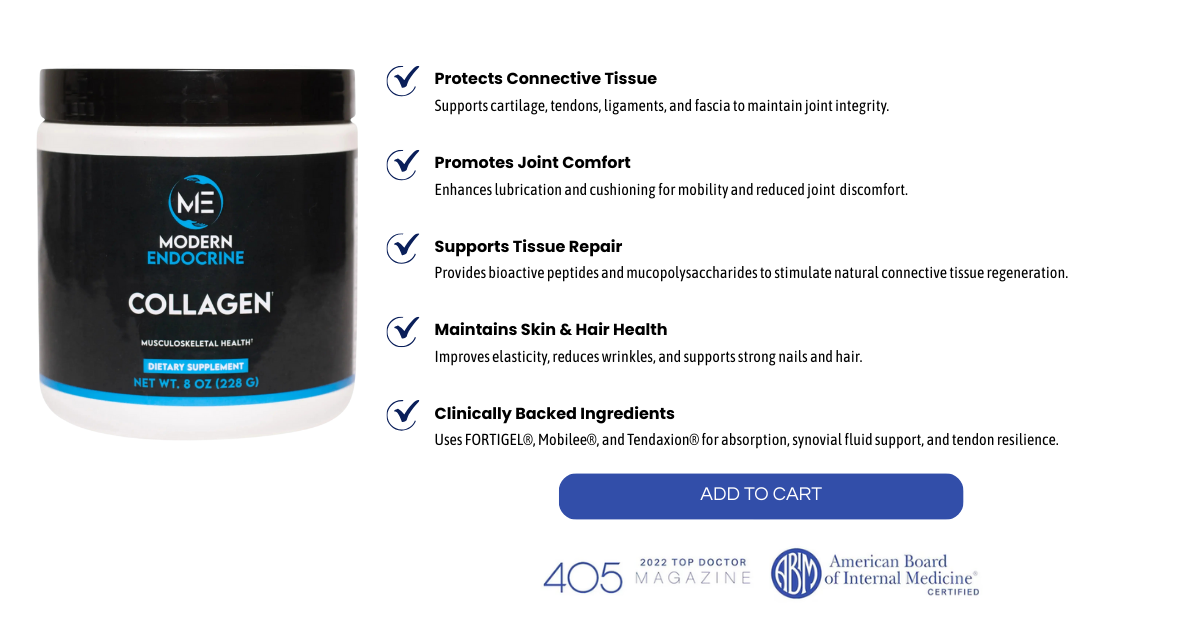
Strong, flexible, and resilient; that’s what collagen does for your body. This targeted formula supports healthy skin, joints, ligaments, and tendons so you can move with ease and look your best at every age.
Is TB500 Right for You?
TB500 is currently used off-label under the care of medical professionals. It’s not a one-size-fits-all solution, but when strategically incorporated into a personalized healing plan, it can help reactivate your body’s natural repair pathways.
At Modern Endocrine, we use evidence-based tools to support longevity, performance, and vibrant aging, and TB500 fits right into that vision.
References
Goldstein, A. L., Hannappel, E., & Kleinman, H. K. (2005). Thymosin beta 4: Actin-sequestering protein moonlights to repair injured tissues. Trends in Molecular Medicine, 11(9), 421–429. https://doi.org/10.1016/j.molmed.2005.07.004
Bock-Marquette, I., Saxena, A., White, M. D., Dimaio, J. M., & Srivastava, D. (2004). Thymosin beta4 activates integrin-linked kinase and promotes cardiac cell migration, survival and cardiac repair. Nature, 432(7016), 466–472. https://doi.org/10.1038/nature03000
Philp, D., Huff, T., Gho, Y. S., Hannappel, E., & Kleinman, H. K. (2003). Thymosin β4 and wound healing: Involvement of laminin-5 and matrix metalloproteinases. Annals of the New York Academy of Sciences, 998, 163–170. https://doi.org/10.1196/annals.1254.019