
Why Doing More to Heal Can Backfire | The Cell Danger Response with Dr. Eric Balcavage
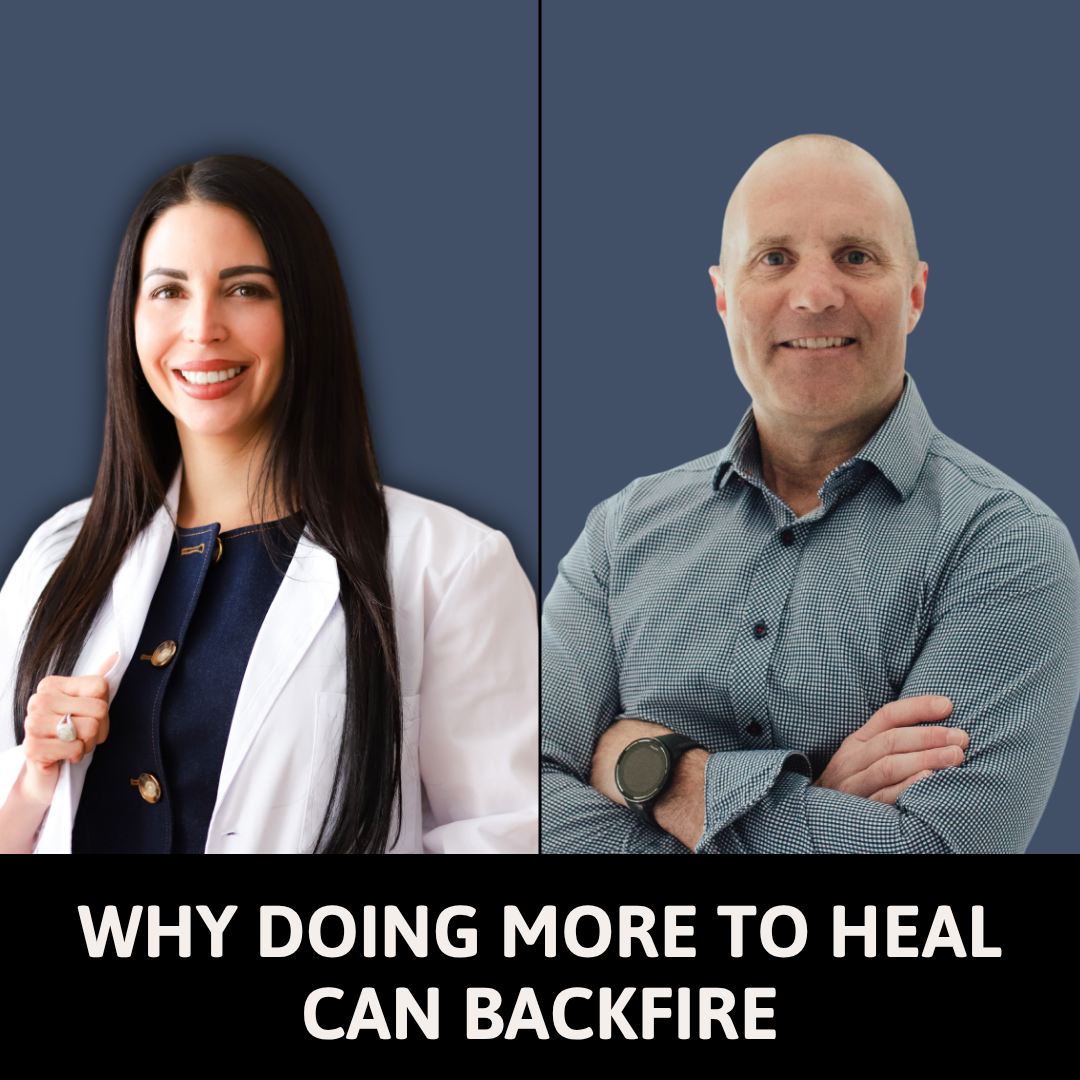
In this conversation, I sit down with Dr. Eric Balcavage to unpack what’s really happening beneath the surface when your body feels stuck, overwhelmed, and unable to heal. We dive into the concept of the cell danger response and why so many people today are living in a chronic state of stress at a cellular level without even realizing it. We also explore the gap between traditional and functional medicine, and why both approaches matter more than we think when used in the right context.
Throughout this episode, we challenge the idea that more is always better when it comes to your health. From overloading on supplements to over-optimizing every part of your routine, we talk about how these well-intentioned habits can actually keep you stuck. I walk through real-life examples and ask the hard questions that help you determine whether your body is in a place to heal or simply trying to survive. If you’ve ever felt frustrated, burnt out, or like nothing is working despite your efforts, this episode will give you a completely new lens to look through.
Topics We Cover in This Episode:
- Why doing “all the right things” can still keep you stuck
- The hidden signs your body may be overwhelmed at a cellular level
- How stress impacts your body in ways most people miss
- Why some people get worse before they ever get better
- The surprising reason your routine might be working against you
- How to tell if your body can actually receive the help you’re giving it
- The real difference between healing and just managing symptoms
- A simple way to start identifying what your body actually needs
If this episode resonates with you, take it as a sign to pause and reassess what your body has been trying to tell you. You don’t need more complexity. You need clarity. Don’t forget to make sure you’re subscribed so you don’t miss future episodes.
Transcript
Welcome back. Today’s episode is such an important one because we’re diving into a topic that so many people are living in without even realizing it, the cell danger response or what you could think of as a chronic cellular stress state. Today, I’m joined by Doctor Eric Berkovitch, founder of state based medicine, host of the Thyroid Answers podcast, author of The Thyroid Debacle. And someone with more than 30 years of clinical experience working at the intersection of thyroid physiology, chronic illness recovery, science, and performance medicine. In this conversation, we talk about the gap between traditional medicine and functional medicine, why traditional medicine is absolutely essential when people are acutely ill or in crisis, but why functional medicine is also so important when it comes to optimizing health, improving resilience, and helping people truly heal long term. And instead of tearing either one down. We talk about why those two worlds really need to be bridged. Then we get into one of the most powerful parts of this conversation, how so many people today are chronically overstimulated, overloaded and stressed, and how they keep trying to heal by doing more. More supplements, more medications, more cold plunges, more workouts, more routines, more optimization, more dieting, more restricting. But sometimes healing doesn’t come from adding more. Sometimes healing starts when you begin to remove. We talk about why your body may not be able to receive the good things you’re trying to give it.
If your system is already overloaded and how stepping back, simplifying, resting, and reducing inputs can actually create the conditions for real healing. And you need to listen all the way to the end of this episode, because Doctor Eric and I walk through six key questions you can ask yourself to help you figure out whether your system is stuck in a cellular stress response, and whether your body may be too overactivated to heal the way you want it to. If you’ve been doing all the things and still not feeling better, this episode is for you. Let’s get into it. Welcome back to this week’s episode. I have a treat for you guys this week. I have Doctor Eric Vukovich, and I asked him to come on the show because I had somebody on a few months ago that talked about cell danger response. And just in general, what’s going in our body from a cellular perspective when we’re really ill and we have chronic diseases. And he has a different take on not only root cause functional medicine, stuff like I do, and has been a practicing physician for a little longer than I have. But he really focuses on this cell danger response, which is fascinating. And you guys loved this episode. There were lots of downloads. So thank you, Doctor Eric, for coming on the show and talking to us.
Yeah. Thanks for having me on.
So before we get going into this cell danger response, what is going on with people? Why are people so sick? Tell everyone and, you know, 3 or 4 minutes about you, like, how did you get here? What are your credentials? Do you even have any credentials to be talking to us about this? Because I think that’s really important.
Yeah, I started as a chiropractor probably 30, 32 years ago. Originally, I was headed to med school, got injured, didn’t get help in traditional medicine, wound up seeing a chiropractor and getting success. So headed off to chiropractic school and chiropractic school. It came out and started doing traditional chiropractic stuff, but I had a family member that got diagnosed with hypothyroidism, iron deficiency, and fibroids. And so the answer for, you know, 20 something year old woman at that time was we take out, you know, hysterectomy, iron and thyroid hormone. That’s it done fixed. My brother reached out to me and just said, hey, like, I need you to figure this out. I’m like, I, it’s not what I do, really. He said, I know, but you’re gonna figure it out. And so in digging into the literature and the research, I started realizing, okay, this is probably an immune driven disorder. Iron deficiency is probably not necessarily iron deficiency. Maybe it’s anemia of inflammation. Maybe it’s going into the fibroid. But there’s reason all this stuff is happening. And then that started me on this trajectory of learning about functional medicine. I went back to my roots in blood chemistry because that’s what I did before going off to chiropractic school. And once you’re in practice, you’re talking to patients on every visit, just trying to chit chat while you’re taking care of them. And I was shocked at how many people were on thyroid medication and still didn’t feel good. And I’m like, well, hey, I’m learning this stuff over here to help somebody else. And that just started this journey and I did the traditional journey with everybody else. And then as we talked a little bit offline, is that it was somewhere probably 12, maybe 12 years ago now, where Doctor Ben Lynch sent me a, a paper on the cell danger response.
And it was like the light bulb moment for what I was seeing from a functional medicine perspective, from a frustration perspective, because functional medicine, as I was taught, it, was very protocol based. Here’s what you see. You do a gut protocol, then you do a detox protocol, then you do a hormone protocol, and then you do adrenal protocol or whatever that order was. But there was, here’s the protocol that you do. And, and, you know, some people got better, the healthy, sick people got better. The chronically sick, sick people didn’t get better, struggled in that model. And I need to understand why because I just didn’t feel like this was human physiology that just one day forgot how to work. It just didn’t make sense to me. And then once you read Navios paper the first time, it’s exciting because you look at the pictures and you go, oh, okay. By about the 20th time you read through that paper, you’re like, hmm, every time I read that paper, I pull something different from it. But it’s really shaped my whole look at functional medicine and what’s going on, especially when we think about thyroid physiology, vitamin D, physiology, all these things, they’re like hot button topics and I just see them totally different. And I think then once I read that paper. So it’s changed the trajectory of my practice. It’s the main reason I wrote my first book, The Thyroid Debacle, and it’s continuing to shape me as a practitioner and be a better practitioner every year for my clients.
So what I’m hearing is that you got frustrated, or you had a patient that was frustrated with the traditional healthcare system. And so that made you kind of look into other alternatives, which is why a lot of us end up here where we are, right? It’s like we do what we were taught, what traditional medicine says is supposed to make people better. But what we know is that a lot of times that doesn’t, right? There’s a lot of trying to put round pegs in square holes.
Yeah, yeah. But I came from traditional medicine, so I was rough on traditional medicine when I left traditional medicine. But now I’m older and I think I’m a little softer. Maybe somebody would say some people would say not, but I don’t think traditional medicine is trying to harm people or hurt people in general. We’ve got great practitioners, but when we look at that model and it’s not successful and we say, I’m trying to get healthcare, that’s not a healthcare based model. And when we realize that, we then become less frustrated. We think it’s a healthcare model, but it’s not really built on the healthcare model, really current allopathic medicine. And you were in it or maybe still in it. And so you could tell me if I’m reading the tea leaves wrong, but modern medicine as it stands today is a fantastic triage, healthcare model, crisis care, disease management, acute care. Great. And we shouldn’t belittle that model. And we do that sometimes in these crazy medical doctors. They only run TSH and free T4. How stupid is this? Blah blah blah. We say these things in functional medicine, but that’s not allopathic medicines. Job is not to look at the conversion of T4 to T3. What’s happening at a cellular function that’s not I don’t think that’s what your training was the role of traditional endocrinologists medical doctors in thyroid world is when is the gland dysfunctional enough that I either have to cut it out or provide prescription medication, and that’s when treatment starts and they don’t treat it sooner. That doesn’t mean it’s bad, it doesn’t mean it’s wrong. But what most of our clients want when they’re frustrated is they want to return to healthcare. They want to return to resiliency. And that model just doesn’t fit it well because we don’t do the in-depth testing in that model, and we don’t really look for root causes in that model, which is what we should be doing in functional medicine.
Yeah, I think that’s a really important point, doctor Eric, is I see this all the time, traditional healthcare in this country. You know, we are America, United States, one of the most powerful countries in the world and very educated as well. Not saying we’re the smartest, but we are when it comes to medicine in general. Very educated people from all over the world come here to go to medical school. Our traditional medical system is wonderful at emergency care, right? If you are sick, you are dying. I mean, we have some state of the art healthcare here, right? I worked in ICUs. We have protocols. We should not discredit that. If you break your arm, if you’re having a Stemi, a heart attack, a stroke. I mean, yes, but to your point, traditional healthcare is not made to keep people well and functional long term. It is more of this. I like to call it a band aid approach, but I guess that’s just how it was formed. And to your point, I never really thought about this until you were saying that there are millions of people that that’s all they want, right? There are millions of people out there that in this point in their life, they’re not thinking about being sick because they’re healthy. Right? And they do want to utilize a healthcare system where, hey, I have an acute, you know, I’m sick, I have a pneumonia. I have, you know, a bronchitis. I broke my arm, I need my gallbladder removed. And that’s what they utilize healthcare for.
And we do really well at that with traditional medicine. But unfortunately, for whatever reason, there are millions of people now who want to utilize healthcare for a different reason, which is why am I having these symptoms? Why do I have this disease process? Why have I been diagnosed with this autoimmune condition? And that’s where functional medicine and people like you and I really shine. But then to your point, there is differences in functional medicine. There are these. Hey, I’m a functional medicine provider. This is the protocol I run on everyone. This is what you do. And then there are people like you who are very intrigued myself with like, hey, why are these people not getting better from a physiologic cell point? From a cell membrane standpoint, what is going on and how do we fix those people? And so I think that’s a good thing to point out. And whenever I do talk about traditional medicine, sometimes I do think like, oh my gosh, this is crazy. Why don’t they do this? But you make a good point of like, traditional healthcare wasn’t made for that, right? It was, it was made to keep you from dying urgently, right? Or to fix a problem instantly. So it’s just, I think that medicine is evolving and changing as we have more technology, as people are living longer. And so we really should think about it as different buckets. I think that’s a good way to think about it.
Yeah. And it matters too, because if we start explaining this way, then people go, oh, I need crisis care. That’s my medical doctor’s really good at that. That’s where I need to see. But if you know that they don’t do what we would call true healthcare or functional medicine, you wouldn’t be expecting them to do it. And you’d understand why they don’t run the tests they do, and why insurance doesn’t cover some of the things that you would think should be covered. I mean, I often tell people like, I wouldn’t ask my plumber to run all the electric in my house. Like, I just wouldn’t do that because I’d come home and I’d have plumbing everywhere. Everywhere. I went to switch, I got plumbing and I’d be like, well, why did you run the plumbing? Or why did you run? Why didn’t you run electric? Well, because I’m a plumber. Why do you think I did it this way? Right. So I think it helps. And I’ve started trying to kind of reorganize my thinking around things. And that’s where I think about like we should be thinking from a state based perspective. And this is this allows space and room for everybody in the model, right? So if somebody is in crisis care or they’re in overload, they need triage, like we need right away, we need to stabilize them.
Whatever’s going on, whether it’s high blood pressure, they’re in Hyperthyroid state. They are having a cardiovascular event. Number one thing is triage. They have their max capacity proinflammatory. We need to stabilize the situation. That’s where medicine shines. The problem is when we talk about, okay, what’s healthcare and how do I get healthy? One, we don’t have a great definition of health, especially from that model. And two, if we don’t put these classification out there and show where the tools match the state, then we get frustrated when we take a blood pressure medication and normalize blood pressure and say, okay, I’ve restored your health. You’re now healthy. Well, no, you’re not healthy. We just managed your blood pressure. That’s why your circulation is going down. That’s why your brain’s not working is because we managed your blood pressure, so you didn’t have a heart attack. But we also reduced blood flow and perfusion to your extremities. So it’s really important, I think, for us as clinicians to really understand those things. And I think it’s really important for the patient to understand what do I want? And am I asking the right person? And is that person applying the right strategy to the state I’m in currently? Because that matters too.
Yeah, I think resilience is a good word that I thought about when you were talking. Like I think traditional medicine takes into account, like you said, fixing somebody, fixing the problem right now, the problem is that our body is very resilient. And so to your point, you can sort of bandaid and fix emergent situations, but at a cellular level, at a functional level, in general resilience, our body is trying to resiliently fix things, right? It’s kind of like if a house foundation has has little cracks here and there, and we do little things to just cover it up, right? Or like our plumbing is leaking and so we just duct tape it. You can only do that so long. And then unfortunately, our body, no matter how hard it tries, it is resilient, but it’s going to crumble. And so I think that our healthcare system is good at, you know, emergently making sure that we’re not leaking or our house isn’t going to fall over. But functional medicine comes in and really like when we have all these cracks everywhere, let’s go back to the foundation and make sure, you know, because I see these people, I like to nicely talk about them as metabolic dumpster fires.
I don’t know if you know what I’m talking about, but like you get this patient that’s like, oh, I’m, you know, I, my doctor says, I’m fine. My labs are fine. Right? And they’re like, on this brink of in six months, they’re not going to be fine, right? Like their CRP levels are high, their insulin’s high, their cortisol is high. They’re not converting T4 to T3, their antibody levels are high. Their liver enzymes are starting to get high, like from a metabolic holistic cell membrane. Like anything that could be screaming for help. They’ve got acid reflux. They’re constipated. It’s like they’re a metabolic nightmare. But yes, their labs are still technically normal. They’re not optimized. And it’s like one little thing, right? Like a really bad, you know, food poisoning, a infection, you know, God forbid they get Covid, something like that is going to push them over the edge. Right? And so we’re not good at finding these metabolic dumpster fires and starting to put them out before they implode.
Well, I agree with a lot of that. And the issue is, is that again, part of that is the training, right? It’s probably not. And, and time with clients that makes probably a huge difference. And what the patient’s coming in for. But you know, when we think about labs and this happens in both allopathic medicine and functional medicine, oftentimes we’re running limited labs because that’s how we were trained. That’s how I was trained. You run the labs that confirm your diagnosis. And my question in class was, what if my diagnosis is wrong, right? Maybe if I ran Fuller Labs, I’d get a different picture of what’s going on. And that’s we were no diagnosis run labs to confirm diagnosis. So the issue with labs right now is especially in I don’t know how traditional medicine does it so much, but they’re limited labs. Part of that’s driven by insurance. Part of that’s just guidelines for care. And you run limited labs with limited contacts. So I run it. We’ll use thyroid again, TSH and a free T4. And the patient I’m looking at the patient going, hey, that patient’s they look hypothyroid. Hair is thinning starting to gain weight. Dry skin. They don’t look very healthy. They probably have hypothyroid condition. So we run two labs TSH with reflex to free T4. If TSH is normal free T4 never gets run. They may still be within the lab reference range. And we look at them and say, well, they’re developing a thyroid problem, but I don’t have justification to treat them yet because these values are still normal. So eat less, exercise more, take it in and you’ll be good. And if we ran a fuller picture and or interpret the labs differently. Not for high or low, but is the lab value normal and appropriate for the patient in front of me? Is the lab value abnormal but totally appropriate for the patient in front of me? Is the lab value abnormal and inappropriate, or is the lab value normal and inappropriate? I think I got them all right.
So there’s four different criteria there. But we don’t do that when we run without context. More labs, different interpretative path thought process. We just look at the individual value. Is it in the lab range? Yes, it’s in the lab value. But you and I both know that a lab value can be totally normal, but inappropriate for the patient because as you use TSH as an example, somebody early in an inflammatory process, TSH is often normal, being suppressed by inflammatory mechanisms. And you could have low T4, low T3 in a window where TSH is totally normal. So if you ran a TSH with reflex to free T4, you may totally miss it because you didn’t run a big enough panel. And so we have to interpret labs better. And I think at least starting off, I want as much context as I can get on a patient through labs and their health history and their signs and symptoms so that I can interpret them because you can’t do a good job interpreting somebody’s labs if you don’t know their health history, if you don’t know their signs and symptoms, you don’t know their medications they were on at the time. You don’t know their supplements at time to time. You just look at TSH and go, hey, TSH is good. Free T4 is good. You have no problem based on what? Where’s the context? What context are you using? Does that make sense?
Yeah, I mean, it makes sense to me. That’s what I do all day long. But I think it’s hard for people to understand that patience. And it’s really hard for providers to understand that too, right? Like I thankfully now, so I’m even transitioning my practice further. I currently spend 30 minutes with every patient. I’m transitioning it to 45 to an hour. And so we can talk about how are you sleeping? How do you feel when you eat? Are you exercising? Like, how do you sleep? And we really dig into like, symptoms because your body will tell you when there are issues, right? And this is what I want to talk to you about cell danger. But like, first of all, a lot of people are so chronically stimulated that they don’t even know how they feel. Right? Like I talk to people every day where it’s like, you should do yoga. And they’re like, I hate yoga. Why? Because I like my brain goes crazy, I get anxious, I that is totally opposite of what should happen when you do yoga, right? When your parasympathetic nervous system is activated, you should feel calm. But most people, when that happens, their body freaks out because they’re so chronically stressed all the time that their bodies like, oh my God, am I dying? Why is everything so calm? I mean, that’s a huge problem.
You need to know that when you’re interpreting somebody’s labs, right? Like you can have my labs and, and your labs and, and they’re going to mean very different things based on the symptoms that that person is having. Because again, I feel like humans are very resilient. Your body will start to adapt as much as it can, right? And so having symptoms with the lab, I mean, this is the hill I will die on. You have to know what’s going on. You also have to know like what’s going on in this person’s gut because and we can talk about that, but your gut affects inflammation. It affects how hormones metabolize. It affects cell membrane receptor availability of hormones, lots of different things. And so yes, to your point, we have to look at this as a more holistic approach. Or people are never going to get better long term. Now, does any of that really matter when you’re bleeding profusely or dying? No. Right. I mean, we know that we need to stop the bleeding or you’re going to die. And this is where, again, traditional medicine and functional medicine are very different, but it’s just a whole different approach. And it’s almost like, you know, people have asked me, Cassy, how do we fix medicine in the United States? And I almost feel like there needs to be like two different schools almost, right.
Like there is the traditional medicine school of like, hey, this is how we fix someone when they’re dying. And then this is the school of like, this is how we keep them healthy long term. And not that there shouldn’t be some blending of that, but it’s just different. It’s totally different when you go to your primary care doctor, what they’re looking at, they’re looking at your labs to make sure, hey, there’s nothing crazy here. I don’t see a sign that you have cancer or something like that. Versus when you go to somebody like you or I and we’re like, hey, you have some insulin resistance, your liver enzymes are going up metabolically. This isn’t looking great. If you look at things like HRV, like I saw a lady yesterday who her hrvs like nine and ten every single night and she’s like, oh, what’s wrong with that? I’m like, well, you’re gonna get dementia and die. You know, I mean, multiple things. You’re sleeping four hours a night and your HRV is nine. Your longevity prognosis is very bad. So it’s just very different. You know.
It is. And I, I don’t know if we’re going to separate it. Right. And I think we already have kind of a rough framework for it, but just like we should have a Department of war and we should have a Department of Peace, right? Because they have different missions, we need to define health. So we have a what the standard is like, what does that even mean? What does it look like on labs? What does it feel like? What’s our definition of it? Because they’re all kind of nobody’s. We don’t have a uniform definition. Really. That’s valid. Two I don’t think we have to throw the baby out with the bathwater from a traditional medicine perspective, because it’s already one of the best trainings in the world, right? But we just have to build a bridge. Like, I don’t know how it is with you. When I left, traditional medicine came to chiropractic and functional medicine, it was like, oh, you know, I was anti medicine for a while and I don’t think that’s healthy. I don’t think it builds the bridge. And I think the challenge is we just have to help each other as clinicians understand. We just have different roles and we have to help help our patients understand. So they’re not because you you probably get two people. Patient people are pissed when they my doctor won’t run this stuff. I listen to a podcast or a IG Instagram thing and I told him, this is what you have to do to assess.
The clinician doesn’t want to hear all that stuff. You just need to know that they do a different job. And if we can all work together and they can get you stable and then you go, but I want more than this. Hey, Cassie. Down the street. Go see Doctor Cassie. She does. She does healthcare. I do management care. Do you want management? I can manage it until the cows come home, if that’s what you want. You don’t have to change your diet. You don’t have to change your lifestyle. You can drink and smoke and stay up as late as you want. You can party as long as you want, but if you really want health, that’s not what I do. And we have to be okay to say that and say, but Doctor Cassie does go see her. I’m still your physician. I’m still part of the team. But if you really want health care, that’s not what I really do. I’m about disease management. If you got crisis issue going on, I’m the guy for you. If you need, just want to manage your health with meds or your symptoms with medication, I can do that for you. Insurance will cover that. But if you want, health care doesn’t really fit in the model of what I do. But there is somebody I know really well down the street and they do a fantastic job of it.
Yeah, you know, and I think that’s fair because I do that with patients too, right? I’m like, hey, I have people that will message and like, oh my gosh, I can’t breathe. And I feel like I have pneumonia. And I’m like, you need to go see your primary care doctor. You need to go to urgent care. You know, like I don’t do chest X-rays. I don’t give steroids and antibiotics like you need your primary care doctor or, you know, hey, I fell and I think I broke my wrist. You need to go get that evaluated, right? And I also have had people who have come to me and have just been brutally honest with like, hey, I came to you because I know I’m sick, but I don’t want to do anything different. I’m gonna drink a pint of whiskey a day and I’m not gonna exercise and I’m not. And I just tell those people, I’m like, hey, you know what? I really appreciate that honesty. You’re going to be wasting your time with me. Like you might as well just go back to your primary care doctor because you have to do work to get better, right? Your health is not owned.
It’s rented. And the rent’s due every single day. That has been on my refrigerator for years. And I read it every morning and I believe that. And so it’s kind of like if you want to get in shape and build muscle, it’s not something you do and then quit. So I think that, yes, that’s a good point. And people need to understand that because I’m very happy telling people, hey, you know what? I don’t think I’m going to be the best fit for you and I don’t want you to waste your money. You might as well just go see your primary care doctor. But I do think it’s important that primary care doctors take that same mindset like, hey, if you don’t want to do what you and I do, that’s great. We need you to treat pneumonia and bronchitis and, you know, reset people’s arms when they break them. Like we need you to do that, but then you need to just, we need to lean on each other and, you know, hold.
Yeah. But we need to build a bridge, right? Because traditional medicine. I’ve worked with multiple medical physicians who still come to me for help and they’re like, I don’t even know what functional medicine is, but somebody told me to come talk to you. Right? So they don’t know there’s another universe sometimes some of these people. So I guess we could be mad at them, but it doesn’t do us any good. I would rather build a bridge and really do some housekeeping in our own area, because I think we got some work to do. From a functional medicine perspective, I think we’ve lost some of the the original ideas of what functional medicine is or what it should be. And we’ve shifted to essentially greenwashed medicine to some degree with people set protocols, just replacing drugs with supplements. You must have run into the patient who come in, they’re on 30 or 40 different bottles of supplements every day, 120, 130 capsules per day. And they think that’s functional medicine, and that’s not functional medicine. That’s just greenwashing, traditional medicine. It’s more expensive. It’s not covered by insurance. And many times people don’t really understand that much of what they’re doing with those supplements is actually not healthy, even though they’re natural ingredients, it’s actually pushing the system harder. I talk about demand versus capacity, and when you put more stuff into a body, more hormones, more T4, more T3, more supplementation, more whatever, you name it, that many of those things aren’t neutral thyroid hormone. You put it in the system, it’s not neutral. More thyroid hormone increases demand. And people could say, well, I’m just optimizing T3, but if you optimize T3, it’s not just optimizing the blood level, it’s pushing the tissues in the cells harder. And if you believe that the person has the capacity to push it harder.
Okay. But if you don’t, you may temporarily change some signs and symptoms or some labs, but you’re actually increasing the demand on that person and actually may accelerate their decline. And we’ve got to be careful with that. The supplements are never the answer. They’re a tool. Drugs are a tool. They manage condition. They rarely ever fix it. Supplements rarely ever fix the condition. They’re tools to help us in the progression from overload to adaptation, adaptation to resiliency. Now, if we want to have a discussion about root cause, let’s do it. But it’s not supplement deficiency. I pretty much guarantee it’s not a supplement deficiency. It’s not a medication deficiency. It’s the stuff that nobody really wants to deal with, which is life, lifestyle, habits, behaviors. You could talk toxins and bacteria and all that stuff. But again, if we even from a gutie perspective, and I, I think the gut is the root of a lot of challenges, but when somebody’s done their fourth or fifth gut protocol and they’re coming for you for the next gut protocol and you’re the first 5 or 6 didn’t work, we have to stop and pause and say the gut is a effect of the chronic stress in the state of your system. Your system is in overload. It’s not going to repair. It’s not going to regenerate. It’s in a pro-inflammatory state. Sympathetic overdrive, parasympathetic downregulation. That’s why you’re not generating stomach acid, bile flow, pancreatic enzymes, maintaining the tight junctions, immune integrity, or bacteria. You can only do so many protocols and realize that they’re not working before you start to say that wasn’t actually the root issue, but it, to be fair, huge problem for people, right?
No, I completely agree. I think that’s a good point is, you just lifestyle’s not sexy, right? When you talk to somebody about their lifestyle and their stress and how much they drink and how much they sleep, what I find is people, a lot of times get defensive. And sometimes I have to tell people like, I don’t. This is not meant to be a defensive conversation. This is not meant to attack you or tell you what you’re doing is wrong. A lot of times people’s lifestyle is almost like it’s just their way of coping or like their way of just getting by, right? It’s just what they’ve done to survive. It’s like a survival mechanism, right? And it’s not to say that you’re doing it wrong. It’s just saying, hey, let’s unpack it, let’s unwind it and let’s see if there’s a way that we can start making it better. Right? Like I had a conversation with a lady this week whose husband is really sick and she’s helping care for him and she has to feed him and, you know, and so she said, I’m not sleeping like I’m supposed to. I’m drinking too much. You know, in her way of dealing with the fact that her husband is sick and being stressed is that she drinks. And so we just had to have that conversation.
Hey, I’m not telling you that’s the wrong way to do it. I’m not blaming you. It’s just like, how do we start using that drinking? Like, how do we change that habit, right? How do we do something else that gives you dopamine or help you relieve your stress? Because until you do that, your HRV is going to be ten. You’re going to wake up ten times in the middle of the night because you’re menopausal and you’re drinking alcohol to go to bed. You know what I mean? It’s just like, this is not a blame game. It’s just like, how do we help you give yourself better inputs so that we get better outputs? None of that is sexy. None of it’s easy. Nobody ever wants to look in the mirror, myself included. Sometimes I’m like, dang, I suck at that, you know? But I think as a society, we also need to just stop being so hard on ourselves, start encouraging each other like, hey, how can we help you fix this? How can we help you feel better? And so it’s hard. It’s not easy, especially providers like you and I, right? This is not something we were trained at. Trained to do. Trained, you know, in school. But sometimes that’s what people need. You know, I kind of joke that a lot of my day, sometimes I end up being a therapist because it’s like somebody just really needs to, like, vent and tell somebody why they’re doing this.
And sometimes they just maybe need to bounce off somebody. Hey, what can I do besides drink a bottle of wine every night after I feed my husband who’s sick because I want to cry and I’m stressed out? You know, it’s just their survival mode. And so I think to your point, and I kind of want to get into this cell danger response, but like in that person, there’s cell danger response is probably very high, right? And they’re stressed out and they’re making a lot of cortisol. And until we can change some of that input of the stressed feeling and the excess alcohol every night and the lack of sleep, that’s just going to keep getting worse. And it doesn’t matter how many supplements I give her, it doesn’t matter how much hormone I give her, how much thyroid medication I give her. Until we remove some of that toxic alcohol, we help some of that chronic stress that she’s feeling because of lack of dopamine, and we help her sleep more. Doesn’t matter what I give her. She’s not gonna feel better, right? I mean, period.
I totally agree, and that would be my point. This is a person in overload. They need triage care, right? So if we were thinking about this from somebody in debt, right? If you’re in debt, what do we have to start doing first? Do we start giving you loans so you have more debt? Or do we start saying, what the heck are you spending your money on? Right? Let’s stop spending money. You don’t need the $7 coffee at Starbucks. It’s not that good anyway, right? What do we need to do? And so in that situation, we have to start looking at the key, you know, foundational things. And I talk about these things. I call them fitness factors, but what’s your dietary fitness right now? What’s your calories? What’s your macros? What’s your burn rate? Are you even close? People think they are, especially people who are overweight, but people are shocked when they realize how much they actually need to be putting into their body. And especially if they’re overweight, they’re like, I’m already overweight. That’s why I’m not eating those cows. I’m like, well, you’re creating part of the problem. So we have to be aware of those things. If you’re not sleeping, you can’t repair. If you don’t repair, you can’t make energy. No wonder you wake up tired and exhausted. That adenosine wasn’t rebuilt into ATP because you didn’t sleep enough. Your brain didn’t get recalibrated. So a part of the reason you’re tired and fatigued and exhausted, you need the caffeine to get through the day is because you didn’t get appropriate sleep.
So if we’re going to help you get healthy or improve your health just so you can start repairing, we’ve got to get you out of this overloaded state, and we have to do whatever we can to stop the depletion. All of the caffeine, all the alcohol, lack of nutrition into the system, disrupted sleep. These are key foundational things. And just like you, we are therapists. You know, we want to be thinking about it or not, but these are things that, you know, for me, there’s foundational things when somebody comes to see me, you know, a lot of times people want, I want this, what’s the supplement? What’s the just tell me what the dose of T4 and T3 is. It’s going to fix it all. Like it doesn’t exist. You’ve already been down that route for the last five years. It doesn’t exist. Do you want to manage your thyroid or do you want to recover your thyroid physiology? I’d want to recover it. Okay, then we’re not worried about those numbers right now. We’re worried about these things. And foundationally, I want to know what their physical fitness looks like. I want to know what their dietary fitness looks like. I want to know what their mindset fitness is like. I want to know what their habitual fitness is like.
What do you do from the start of the day till the end of the day? Tell me. I don’t know exactly what you’re doing. And then last of all, sleep fitness, those are my primary five. Because if someone’s got terrible habits, right, I wake up with a little shunt, then I go do some, you know, whatever. I have a couple cigarettes. Like this isn’t a person who’s on a health journey or, you know, these people. I get up, I do my fasted whatever, I take 27 bottles of supplements first, then I go do my plunge and then my sauna, and then I do an hour and a half of cardio. Then I do strength training. Then I go back in the hot tub again, and then I meditate for 27 hours and then, you know, and there and I’m making fun. But the person who is so driven to do everything right, and yet their health is a mess. And you’re like, they’re looking for that. What’s the one thing I’m missing? I’m just trying to optimize it, right? You’re not even in a state to optimize your system right now is overloaded and it’s optimized for that state. That’s why you’re loaded with inflammation. That’s why your urolithin A is not working. That’s why your CoQ10 doesn’t work. They all work well. If you need 36 bottles of supplements to feel this shitty, why? What are they doing? Right?
So I’m laughing, doctor Eric, because this was literally me like five years ago, right? Like right when I get into functional medicine and I like, I have Hashimoto’s and I have insulin resistance and PCOS, and I was having infertility issues. That was literally me. I woke up at 430 in the morning and I had this like very strict morning routine where it was like, okay, I’m doing this. I rebounded and I meditated and I did fasted cardio and I did my cold plunge and I did red light and I did sonnet and I took 47 supplements. And by the time I got to work at 8:00, I was like, I am so damn stressed out. I don’t even know. And so I did that for like a year. And I’m like, man, none of this is working. Why? And then I kind of got to this point where I was like, screw it. And I just kind of did whatever I felt comfortable with. And it’s actually really crazy how if you just listen to your body, it will tell you exactly what you need, right? Exactly. And I think that’s a lot of people’s issue is like, and I talk to my health coach, Sarah, about this all the time. Like sometimes we get a little like, hey, we really want to clean out your gut. We want to help you with this. But sometimes with people, you just have to step back and say, you know what? I’m not gonna push anything else. Like what we need to do is figure out what can we remove, right? Let’s just start with removing coffee or caffeine or sugar, and then just slowly start to add things because some people are so again, just like so many inputs are coming in that it doesn’t matter what you try to force into them.
It’s nothing works. And you know those people, right? Because. And we’d argue it’s the tool, right? My friend took this. They made they felt awesome. My other friend took it and they said it felt good for a while, but then it didn’t last, I took it. I feel worse right away. This thing, this tool is terrible. Like T3 is a great example. Like some people like changed my life. Other people like I started at five micrograms. I felt better, didn’t last. I went to ten, felt better, didn’t last. It went to 15. And they’re now 30, 40 micrograms of T3 every day trying to chase the high. They’re like an addict. And then you get the other person who takes five micrograms and immediately they’re like, I feel awful. I cannot take this stuff. And you’re like somebody scratching their head going, it can’t. They’re nuts because it helped this person. The tool has to match the state, but most of the patients that we’re seeing are coming in chronically strained or overloaded. And exactly what you said is correct. And I do this all the time in my practice. We’re starting with not adding more because you’re you already have too much in there. We have to create space. We have to create capacity. We have to reduce the demand. See these supplements? You’re taking these 28 bottles of supplements. All of these are pushing the system. You think they’re neutral. You think you have all these deficiencies. If you have 28 micronutrient deficiencies, you’ve got a gut issue, you’ve got a diet problem, you’ve got a digestion problem, you’ve got a dysbiosis problem, a leaky gut assimilation problem. But if you had one ingredient, then we’d talk about maybe it’s a dietary thing too, but people are already overloaded. They’re overloaded with work, they’re overloaded with priorities, they’re overloaded with thought, they’re overloaded with supplements, medications.
And the key for most of these people, and it took me a long time to figure it out. You’re newer into practice. You’re figuring it out faster, smarter than me. It took me longer. But it’s not about the supplement. It’s not about the protocol. For most of these people, it’s like, let’s take a step back. I know you’re working out six days a week and you love to do it, but you don’t have the capacity to do six days a week. You’re not sleeping. I know I’m not sleeping. That’s why I take these medications. I know, but if you take that medication, then it results in poor recovery anyway. You get fatigue and you’re doing the coffee and I know I need the coffee. Well, I know the coffee you need, but then it takes 12 hours for the half life of this stuff to go down. So now adenosine can’t recover, like can’t rebuild. And now you got this issue. So it’s all about initially reduce, reduce, reduce. And you know what happens. You see this in practice too. I’m sure you’ve reduced five supplements in the first couple of weeks. Let’s do these one at a time. Let’s see how you do. I can’t live without it. Okay, well let’s just see if you do. If you feel worse, we’ll put it back. Let’s see how you do. You talk to him four weeks later. 30% improvement in signs and symptoms, huh? How about that? Well, should I put it back? No, no, we shouldn’t put it back. Right? And then you look at their thyroid panel or their inflammatory markers and you go, and guess what? We ran those tests that were high before and they’re already improving. How’s that possible?
Well, I think part of it too, is that social media and all these influencers on social media and people that don’t even know what the hell they’re talking about make it worse, right? Because people get online and think, oh, well, this person says, I need to take this and I need to do this morning routine and I need to. And so I think we’re just bombarded with so much information that we think, oh, we need to do this, especially women, perimenopausal women, women from 30 to 50. I see so many of them. And I’m sure you do to these type A women that are like, I must do this, this, this, this. I mean, those are the hardest people to take care of women that are like entrepreneurs, business owners. You know, I have one in particular I’m thinking of who like ran ten miles a morning and like, I can’t not run ten miles morning, because if I don’t, then by the time I get to the office, I’m just so flustered and I’m like, no, that’s exactly what you need to not do, right? Because, you know, adrenal capacity left. And so I think it’s just we get bombarded with like, this is what we’re supposed to do. And so we do it. And so it’s changing a mindset, just like I’m a product of the 80s, you know, women that were a product of the 80s. We used to think that like being stick thin was that’s what you needed to do. And the 90s, everyone was stick thin in 2000. You have to change that mindset, right? No, you want muscle and you want to be able to lift your overhead bag into your bin when you’re 80. And so if you’re stick thin, that’s not happening. Same thing with fat, right? It used to be like, oh, you don’t want any fat. Now it’s like, no, we know we need good fat. And so it’s just you have to change your mindset.
Except for right now hard. What do you mean now? Because we have medications that can make you drop 10 pounds in a short period of time. Now it’s fashionable to be skinny again, right?
So we’re going to have an issue with that because these people are metabolically dumpster fires even though they’re skinny, right? They’re skinny fat. So that’s a whole nother issue. But and what’s interesting, I just thought about this when you were talking to about all this was, you know, I went on vacation last week for my birthday to Europe with my husband and we had never been to Europe. And so we get there and my husband has all these things planned. He wants to do all these things every day. And we got there. And the first day I was like, you know what? I’m like exhausted and I don’t want to do these things like. And so I maybe sort of made him upset, but I was like, I think we need to just cancel everything that you planned and let’s just kind of like live life this week and it was the most amazing thing ever. I didn’t have any plans. I didn’t really over exercise. I didn’t take any supplements. I took my thyroid medicine every day and that was it. I had no plan. I ate more food. I probably ate more carbs in one week and just food than I ate three months prior to that. But it was all very healthy Mediterranean food. I walked, I was outside, I felt so good in Europe, like I mean, just no routine, not lifting weights. Living life. Did a little bit of yoga, a little bit of parties. Like I felt amazing.
And then I got back and I was like, oh man, this sucks. I need to get back on my supplements. I need to get back on my in two days. And I’m like, God, I feel like crap again. Like, you know, like, so to your point, like, I do think we need to eat more than we think we do. And we need to just like, not be so regimented sometimes and just listen to our body. Because I did that for a week, I literally just listened to myself. I went to bed when I thought I was tired. I woke up when I thought I was tired. When I wanted to be outside, I went outside. If I wanted to relax, I did yoga. I just kind of did what I wanted to do, and I felt so good. Even eating things and doing things I typically don’t. And then you come back and you get in this like, oh my gosh, I have to, you know, I have to do this and I have to. And I felt like crap again. Now some of it is the food there is obviously better for you, right? But it’s just interesting when you start like listening to yourself and you’re really like dialed in on how you feel because I’m pretty dialed in on how I feel, how even eating bread and, you know, pasta and things that you normally wouldn’t eat, you just feel better if you’re not in this chronic like.
Over, I think it’s the load, right? When you go away, you dump the load huge load. And it feels great, right? Because if you immediately reduce a lot of the load on the system, you have immediate more capacity, right? Hey, I got more reserves. All of a sudden, I don’t spend as much energy on all this stuff, which is, hey, you go on vacation. Everybody notices that typically they go on vacation. You ate better. Maybe, but a lot of people go on vacation. They drink more than they’re used to drinking. They don’t exercise as much, and they eat food that they aren’t used to eating. And they come back, they say, I feel awesome on vacation. It was so much fun. I had so much fun. I felt so great. I woke up, I didn’t feel as tired and fatigued. I didn’t have the stuffy nose. Like a lot of their stuff is gone and that’s like the red light goes on and you go, like, this person doesn’t have a supplement deficiency. They don’t have a thyroid deficiency. They don’t have an anti, they have a they don’t have a conversion issue. What they have is a load issue and a capacity issue. The daily load is greater than their capacity. It’s constantly depleting them. It’s constantly pushing putting them in that adaptive or what we call allostatic regulation starting to ramp up their immune inflammatory system.
Not full blown like cell danger response, but it’s uploaded. And as soon as they unload now they can start to get some capacity. The body’s like, oh, what the heck, what’s going on? And I think it’s amazing for people that they’re like, but I didn’t, I wasn’t as strict on my diet, and I still did go ahead and I did have some alcohol and I did okay. Right. Because you have greater capacity to detox that alcohol. Now you don’t have as much load on your system. You ate some food that wasn’t as good, but you didn’t have as much stress on your sympathetic nervous system. Parasympathetic is probably more upregulated. It’s like, oh, food’s coming in. Let’s start making some acid enzymes and bile flow. And it’s amazing. Like, I think there’s so much innate intelligence in the body and the idea that we just wake up one day and the body forgets to work. I don’t think that’s really what’s going on. I think for most people, they’re just maxed out of their capacity and they got too much load on their plate. And there’s people that I don’t think most people are aware of how much load they’re carrying.
I would completely agree. So if somebody’s listening to this, how do they know they’re carrying too much of a load? They’re in cell danger response. They’re maxed out and they need to start decreasing their load. How would somebody know that?
I’d say, number one, do you sleep 7 to 8 hours straight through the night? Easy.
And if they say yes, then they’re good.
No, but that’s a good starting point. The vast majority of people who are in stress physiology, they’re up around two, 3:00 in the morning because they don’t regulate glucose well and because they don’t regulate glucose well, they’re using stress hormones to regulate in the middle of the night. Those stress hormones wake them up. Yes, they get they’re getting up to pee. But most of the people who are really, really in overload, they struggle to get back to sleep because they say, oh my, but my brain’s going because I got so much to do the next day, your brain’s going because you’ve activated it because you don’t regulate glucose regulation appropriately. So that’s number one. Number two would be go ahead.
No, number one is sleep. So if so if your answer is I wake up in the middle of the night and I can’t get seven, eight hours of sleep, you’ve got a problem. But if you say yes, what’s the next question?
If they say yes, they do sleep through the night. Yeah, yeah. How do you feel when you wake up in the morning? Do you feel recovered? Okay. Do you feel like, you know, if they feel they don’t feel recovered, whether they slept through the night or they didn’t sleep through the night, they didn’t get restful, restorative sleep through the night. They didn’t probably recycle like adenosine back into ATP, ATP. There’s too much in circulation. That would be number two, right? Number three would be because not everybody exercises but I would say number three. Are you hungry when you wake up in the morning?
If they say no, is that good or bad?
It’s bad. Okay. Here’s why you already probably know the answer. People who don’t regulate their blood sugar well through the night, through a fasted state, typically are using those stress hormones to regulate their glucose levels. And because of that, they’re going to tend to have a downregulation of the sympathetic nervous system or upregulation of sympathetics down regulated downregulation of Parasympathetics. And it often causes them to not feel hungry in the morning because their glucose is already in circulation, or they actually feel nauseous in the morning because those hormones have been fluttering around. So people are like, I am not hungry. That’s usually a flag for me that we got some, we got some challenges going on. What else might tell them they’re in overload? Yeah, if they’re on any medication, probably. But if just from a how they feel and function perspective.
Okay. What about I think this is a good question. If you go on vacation, do you feel a lot better? Right. Because I feel like this has always been my goal. And it’s really hard as a business owner, entrepreneur. I mean, I’m sure you know this, but I’ve told my husband this, this is my life goal. My life goal is to not have to go on vacation to escape the stress of my life. And it’s really hard when you own a business, right? Because you’re here and you work and you work and like, the only way I don’t work and deal with problems typically is when I’m gone and my husband knows that. And so he has a role of like, hey, I’m taking you somewhere at least for 2 or 3 days every 4 or 6 weeks. Because if I’m here and there’s a problem, I’m just going to fix it. Like that’s how I am, right? So I think a good thing that I like to ask people is when you go on vacation, do you feel better? Right? And if the answer is yes, I feel astronomically different on vacation than when I’m here, then you have an issue in my opinion, right?
Now some people would say it’s because I don’t live in my moldy home. That’s why. And maybe that’s the case. But for most people, mold’s everywhere. And so it is if they go on vacation to some beach town resort. There’s probably mold in the AC units in that place, so they’re still getting exposed. But it’s a great question. I asked that same question and it is one of those easy ones. When someone like I was on vacation, I felt so much better. Mhm. Mhm. Mhm. What happened when you came right back? Sunday night, I couldn’t sleep. I you know, it’s the same thing. I was right right back at it Sunday night, I couldn’t. Yeah, because you’re anticipating Monday and all the stuff you’re already stressing about the load. So that’s why I think it’s for most people, the supplements are sexy. Medications can manage conditions, manage medications, can manage labs. But for most people, it’s the stuff that they don’t want to talk about. The relationships that they’re saying are great, that aren’t right. The things they’re not, communication they’re not having with the spouse that just plays on them. What happens when you go on vacation by yourself?
Yeah, I see a lot of that too. As a provider, I see a lot of people. I have a lot of difficult conversations with women mostly, and sometimes men with. Hey, you know, I’ve been seeing you for a year. You’ve done everything I’ve asked you to. Personally, your labs are looking better, but you’re still not feeling better. Let’s talk about your spouse. And when we really start talking about that, it’s they’re in bad relationships. They know they’re in bad relationships or their spouse is mad, they’re getting better or, you know, and you have to have difficult conversations with relationships are very important for your health. I would say it’s the person that you marry is as important, if not more important than the career that you pick, because you’re going to spend a lot of time with them, and you’re only going to be as good as the person that you marry, period, or that you’re in a relationship with, or that you spend a lot of time with. If that person doesn’t value health and isn’t good to you and speaks good to you and and gives you a positive outlook on yourself in life and mental space, then you’re never going to get better, right? Because if you’re like driving home thinking, oh my gosh, I’m going home to this person who I’m not sure what kind of mood they’re going to be in. I’m not sure if they’re going to be angry. I’m not sure if, you know, you’re just like already in your brain, like, I’m not sure if I have to walk on eggshells. That’s not good for your health, right? And your body is going to internalize and know that. And so if you don’t feel safe in the environment, you go home to where you’re supposed to be able to relax and, and let go. And then you’ve got a problem.
Listen, I totally agree. And I break down like the load we put on our system. One’s physiologic, right? The physical, the diet, the nutrition, all that. But almost more important than some of those things is our interpretive load. What we think about our relationships, what we think about what people say, like the conversation that goes on in our own brain about experiences. Like because everybody said, well, that’s stressful. That situation wasn’t stressful. You defined it as stressful. It’s how you interpreted the situation because you could have two people go through the same traumatic situation and one person, they come out of it and they thrive. The other person is crushed. It doesn’t mean one person interpreted right or wrong, but it is how you interpret it and how you interpret it impacts your physiology. But bad things happen, but it’s how we interpret them today and how we interpret them. And we use those things to move forward in life. But yeah, relationships are tough. I mean, I’ve had patients where you’re working with them. Same thing. You’re working, working with them. You know something’s wrong. And I’ve had this one couple, the spouse is sitting right there every call, they’re having a great conversation and symptoms aren’t really changing. And one day we get on a call just the wife. And I’m like, all your symptoms are like 90% improved. Like what’s going on? And she’s like, I’m getting the divorce. I’m like, yeah, from who? From the guy that was sitting next to you this whole time. She’s like, yeah, I’m like, you guys seem like you get along so well. She goes, that was a show. She goes, I resented every day living with him. And I’m like, Holy cow. But that’s, you know, you have enough of those experiences. You go. What we see physiologically is oftentimes massively impacted what goes on in the mind. It’s crazy.
Yeah. No, I wouldn’t agree with that more. And so I think relationships are really important. And sometimes it is, you know, more important than people realize. And you’re going to you said, you know, you can have two people and they both go through a same situation and one of them looks at it one way and one of them looks at it another way. Some of that is your ability or your capacity to deal with that decision or that situation, right?
Oh, absolutely.
And this will happen to my husband and I sometimes too, we’ll be in the same situation and then I’ll be like, oh my gosh, that was so stressful or that. And he’s like, no, it wasn’t. And we’ve learned, thankfully through a therapist that we can have conversations. I’m like, well, this is why it stressed me out, yada, yada, yada. And he’ll say, well, this is why it didn’t stress me out, yada, yada, yada. And usually when that happens, it’s because I was tired. I had already had a bad day. Like I just wasn’t under a good ability to take on more of a mental load. And he could look at it more of a like, hey, this is how we’re going to fix it. And he’s usually right. Hopefully he doesn’t listen to this episode, but he’s usually right. And I’m like, okay, it’s because I didn’t show up with the mental capacity that I could have, right? And that’s sometimes what we forget is like when we don’t sleep well, when we have a bad day, when we then sometimes we show up to a situation and we will interpret it very differently.
Yeah. And I think one of the things that’s key there, you said it’s always about capacity because if you have capacity, you can pause, you can take a minute and say, all right, what’s done? What’s going on here? What are the possible scenarios? But when you’re at the limit of your capacity and your amygdala is starting to become the dominant force in the brain, everything’s looked at from a threat perspective, and you think it starts reacting before you do. And all of a sudden now your body is responding without you even really thinking about it. That’s why a lot of people, like I just say that, why did I act like that? We think about that later, but it’s not a personality fall. It is the state of your physiology. How much capacity do you have? I don’t have any capacity left. Everything’s going to be a threat. That smirk is. They’re saying something unique about me. If they did joke about me, they’re making fun of me. Reality. They just don’t like Keith. That’s why they made the book, right? So it is about acetate. That’s the things. That’s one of the things I try to keep what they like, especially couples when we’re struggling. And I’m like, you guys are you don’t have enough acid to really understand what’s going on or taking other person’s perspective. That’s why we. Usually have a better comprehension, a better relationship, right? Brian? Few people in Oklahoma find to have a conversation about things that about them.
Yeah. I think this is going to be a very helpful conversation with people. So to recap, if you’re trying to figure out if your body is maybe too chronically stressed or you’re in the cell Danger response. You should ask yourself, number one, can I sleep 7 or 8 hours a night without being interrupted? And if the answer is no, you can just stop right there and you need to kind of take a step back and figure out, how can we offload some of of the information that’s coming in and how can we kind of reset? Or how do I find a provider like you or doctor, doctor Eric or I to help you with that? If your answer is yes, I do sleep 7 or 8 hours a night, then the question is, do you feel tired when you wake up? And if the answer is yes, then again, same thing. We’ve got to figure out we’re probably in a cell danger response. But if you’re like, no, I feel pretty good when I wake up, then think about, are you hungry when you wake up? So I was good on one and two. But to be honest with you, when I wake up in the morning, I’m usually never hungry. And even the other night I didn’t eat dinner. This sounds terrible, but I just kind of forgot to eat dinner. I was doing things and it was like 9:00 and I was like, oh, I’m not going to eat, it’s too late. And I went to bed and I so I ate lunch at like one, I went to bed, I woke up at five and I wasn’t hungry.
So Maybe I got a problem, but I’m usually not hungry when I wake up. So then maybe you need to look at some things if that’s the issue. And then the other question is, are you on medications and how do you feel? How do you function? Do you feel less stressed when you’re on vacation? So these are some good just so people can take inventory and just kind of think like, hey, am I overloaded and am I, am I in cell danger response? And I think to be fair, most people listening to this, I mean, most people that live in the United States live in this crazy world we’re in now, unless you’re just retired or, you know, do very well with life in general or a health coach or a yoga professional. I mean, you probably have a little bit of overload, right? Everyone can do better. Like I do this for a living and I try to practice what I preach and I’m sure you do too, but we can always improve. So I think those are some good. I like to give people just some takeaways of, of what they can ask themselves and maybe try to improve on. So I want to kind of transition into three questions that I ask all my podcast guests before we go, don’t overthink it. First thing that comes to your brain, and then I want you to tell everyone about your book that’s coming out and how they can find you. So the first question is, what is one food that’s most beneficial and why?
I would say an egg.
Okay. Why are eggs most beneficial?
Well, I think it’s like one of the perfect foods that’s out there.
So you’ve got protein in there. You got some fat in there. You’ve got some other fantastic nutrients in there. So if you got good quality egg fits all, it kind of covers all the bases.
So I go with it.
Okay. What is one thing anyone listening to this podcast right now can do that will improve their health? That is 100% free.
I’m gonna start with, I would say, turn off your social media stuff.
For an hour less a day, I don’t start.
Get off social media for an hour, less a day. I like it and I think you should include in that just any TV blue light, anything. Just be more mindful for one hour a day. And the last question is, what is one thing that you wish you would have known about your health 25 years ago that you would have done differently?
You can’t force health. We all try. If there’s a whole crew of people do it. Longevity and optimization. If you just take enough of these supplements, if you just run harder, you just do all this. We, we believe that we can force optimal health by manipulating lives or whatever. And it goes to what we talked about earlier, reaching a high level of health and resiliency. You don’t force your way there. You have to do things to get there. But you can’t force it there. And so trying to say, well, if I just take more of that or more of this, this will make me healthy. That’s rarely the case. It’s usually healthy habits, healthy lifestyle done consistently, not perfectly, is going to get you to a more resilient state. Not more supplements, not more drugs, not the longest the latest longevity or optimization strategy. Keep it simple.
Yeah, usually removing things is better than adding or forcing. Okay, I know you have a book coming out this summer, so can you tell everyone briefly about the book, how we can support you with the book, how people can find you anything that you want people to know about you?
Yeah. So the book is right now it’s called Is This the Hill? So it’s kind of famous and I just didn’t want to die. I think you even actually used that line today podcast somewhere. And it comes out of this whole idea of we have people that are overloaded and when we’re overloaded, everything seems like the hill. They have to defend the argument, the dish on the counter that shouldn’t have been left on the counter. That’s this remark that somebody made. That person that cut you off in traffic is a major travesty. The person who didn’t hold the door open for you? God forbid is the problem. Or the person who did hold the door open for you is the problem, right? So the people choose today. Two people are too busy trying to every. Everything that goes on in their life seems like the hell do they need to defend? And so the book is about understanding that, understanding why we act and behave the way we do, and how to identify that you’re overloaded, how to start to reduce the load without creating more problems and how to keep. Essentially, I use the metaphor of a backpack that we kind of carry the load in the backpack. How do we keep the backpack from getting loaded right back up again and winding up right back where we were? I originally wrote it as a guide for some of my patients, especially the couples that were struggling because they couldn’t communicate, and I needed to explain to them why it was so toxic to communicate. So right now, books called Is This the Hill? It’s working. Almost got it its final stages and probably be out maybe fall of this year.
I love that. I think yeah, I say this all the time. The hill that I’m gonna die on. You know, right now I feel like it’s the hill that I’m gonna die on is you can’t get anyone better. You can’t fix chronic health disease without looking at somebody’s gut. And that’s just because I know a lot about gut health. And that’s what my book is about, which by the time this airs, my book will be out. It’s coming out next Tuesday, actually, April 7th. But, you know, you make a very interesting concept too, is like gut health. I think looking at cells and just chronic health issues that I’ve looked at for years, a lot of it starts in the gut because there’s a lot of inflammation that starts in the gut. But when I look at people’s gut, a lot of their gut issues start because of stress. And I talk to people about this too, like, how do we rebalance our input? We only get $100 worth of energy. I tell people all the time, you get $100 bill worth of energy every day when you wake up, how are you going to spend that energy if your body needs $60 of that 100 to repair the issues from yesterday and the day before. Then we’re starting with 40. So again, looking at like health debt and just trying to help people understand that, like we’ve got to start figuring out where do we go. And so the hill that I, you know, feel like currently I’m going to die on is that until we look at people’s gut and really start fixing that stress load and fixing people’s gut, we’re not going to get anywhere so very similar, but you even take it a little bit farther. So I really enjoyed having this conversation. You’ve actually sparked a lot of thoughts in my brain. This is almost like a therapy session for me. So I probably you should probably send me a bill.
Oh, that’s all right.
Well, thank you so much. I’m sure my listeners are going to get a lot out of this. So I appreciate you coming in and spending your time with us.
Well, thanks for having me.
That was such a powerful conversation with Doctor Eric, and I hope this episode gave you a completely new way to think about healing. One of the biggest takeaways from this conversation is that sometimes the answer is not doing more. It’s doing less. If your body is stuck in a chronic stress response, overloaded with inputs and constantly pushed to overdrive, then adding more supplements, more routines, more exercise and more pressure may not help. In fact, it may be the very thing keeping you stuck. And those six questions we talked through at the end of the episode are such an important starting place for understanding whether your system is overactivated, and whether your body is really in a place where it can heal. If you loved this episode, I would love for you to do a few things for me. First, please make sure you’re following the podcast so you get every new episode. Second, please leave a review because that’s one of the biggest ways this podcast reaches more people. And it also helps me know that this is the content that’s helping you. Third, come follow me on social media at modern endocrine underscore, because that’s where I share so much free education tips and resources.
Also, if you want to go deeper, consider picking up my new book, Fix Your Gut, Fix Your Hormones, available on Amazon, and make sure you go to the website to get all the free resources that go along with the book. If you’re listening to this and thinking, wow, I really do feel like my body is stuck in a cellular stress response, or I think I may be in this cell danger response state and I need help figuring it out. Consider becoming a patient at Modern Endocrine. We have a license to practice in 46 states via telehealth and have a state of the art location in Oklahoma City. Go to WW endocrine and fill out a discovery form so we can figure out if we are the right fit for you. If you’re in a cellular danger or cellular stress response, we can help you identify that and help you start moving in the right direction sometimes by removing instead of adding. Thank you so much for being here and I’ll see you on the next episode.
Dr. Eric Balcavage Resources:
Instagram: https://www.instagram.com/drericbalcavage/
Facebook: https://www.facebook.com/drericbalcavage
YouTube: https://www.youtube.com/@askdreric
TikTok: https://www.tiktok.com/@dr.eric.balcavage
LinkedIn: https://www.linkedin.com/in/dr-eric-balcavage-b85ab111/
Resources:
Check out the website
Follow Cassie on Instagram
Follow Cassie on Facebook
Follow Cassie on YouTube
Follow Cassie on TikTok
Disclaimer:
The information presented including any materials discussed, referenced, or linked within this podcast are for general educational purposes only, not the practice of medicine.
No doctor-patient relationship is formed from you listening to this podcast or utilizing any of the information provided.
I am a doctor, but I am not talking to you as your doctor. The information provided is not intended to diagnose or treat health problems or take the place of the professional medical care provided by your doctor.
If you are experiencing any health problems, including problems you believe have been touched upon in any respect within this podcast, you should consult your doctor about the problems without delay. You may ask your doctor whether he or she believes the information I have provided would be helpful to you, but you should still consult your doctor immediately and follow his or her medical advice as your treating physician.
I’m just here to provide you with basic knowledge about the issues we discuss so you are more aware of them and can better discuss them with your doctor.
Join me on the next episode as we continue our journey.