
Why Gut Health Changes Everything: Dr. Vincent Pedre on Healing from the Inside Out
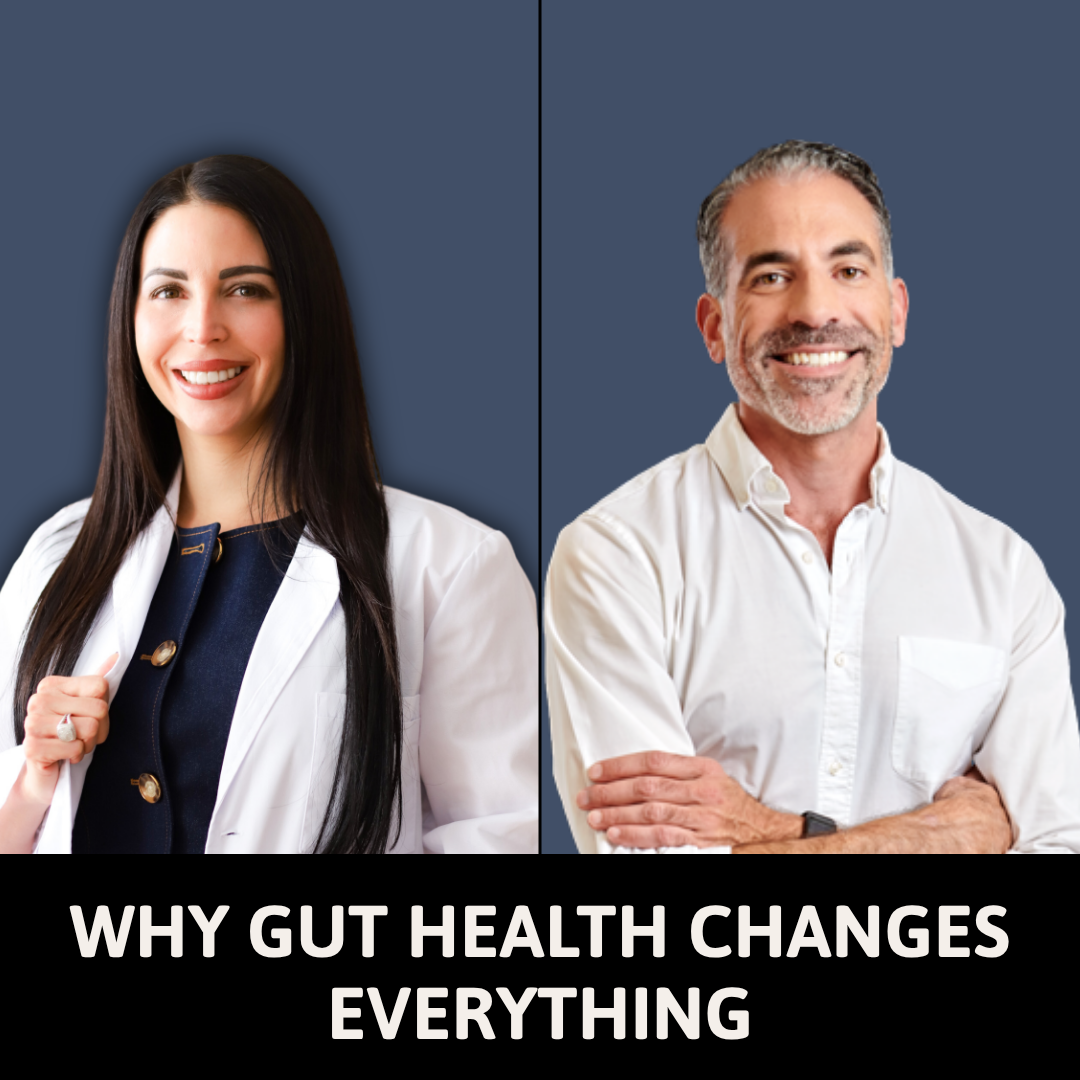
This conversation completely changed the way I think about healing and I know it’s going to shift things for you too. In this episode, I sit down with Dr. Vincent Pedre to unpack why so many people are stuck dealing with fatigue, hormone imbalances, inflammation, brain fog, and digestive issues and why the real answer almost always comes back to the gut. We dive into his personal health journey, how years of antibiotics and chronic illness led him to functional medicine, and the moment he realized that healing the gut is the foundation for healing the entire body.
We go deep into the connections most people are missing, from how the gut impacts hormones, metabolism, and the immune system, to why healing today is far more complex than it used to be. I also ask the questions you’re probably wondering like why quick fixes aren’t working, what role stress and the nervous system play, and what actually needs to happen to create lasting change. We also talk about the “non sexy” foundations of healing like sleep, sunlight, nutrition, and daily habits, and why skipping those is often the very thing keeping you stuck.
Topics We Cover in This Episode:
- Why gut health might be the missing link behind symptoms you wouldn’t expect
- The surprising reason healing feels harder now than it did years ago
- What most people get wrong about inflammation and hormone imbalance
- The hidden role your nervous system plays in your ability to heal
- Why doing everything “right” still doesn’t always lead to results
- The connection between your gut, stress, and long term disease risk
- A different way to think about weight loss, metabolism, and GLP-1 medications
- The foundational habits that matter more than any supplement or protocol
Start paying attention to what your body has been trying to tell you and take that next step toward real healing. Whether that means diving deeper into your gut health, getting personalized support, or simply committing to the basics you’ve been overlooking, this is your reminder that change is possible when you address the root.
Dr. Pedre’s Resources:
Instagram: @drpedre
happygutlife.com – Supplements, Happy Gut Coffee, and the 28-Day Gut Reset Program
TheGutSMARTProtocol.com – Dr. Pedre’s second book
Resources:
Check out the website
Follow Cassie on Instagram
Follow Cassie on Facebook
Follow Cassie on YouTube
Follow Cassie on TikTok
Disclaimer:
The information presented including any materials discussed, referenced, or linked within this podcast are for general educational purposes only, not the practice of medicine.
No doctor-patient relationship is formed from you listening to this podcast or utilizing any of the information provided.
I am a doctor, but I am not talking to you as your doctor. The information provided is not intended to diagnose or treat health problems or take the place of the professional medical care provided by your doctor.
If you are experiencing any health problems, including problems you believe have been touched upon in any respect within this podcast, you should consult your doctor about the problems without delay. You may ask your doctor whether he or she believes the information I have provided would be helpful to you, but you should still consult your doctor immediately and follow his or her medical advice as your treating physician.
I’m just here to provide you with basic knowledge about the issues we discuss so you are more aware of them and can better discuss them with your doctor.
Join me on the next episode as we continue our journey.
Transcript
Welcome back to the podcast. Today’s episode was recorded live at the A forum spring conference in West Palm Beach in April. And trust me, if you’ve ever struggled with fatigue, hormones, inflammation, brain fog, digestive issues, or just felt like your body isn’t working the way it should, this is an episode you do not want to miss. I’m joined by Doctor Vincent Pedre, the medical director of Pedre Integrative Health. Founder of Doctor Pedre Wellness and CEO and founder of Happy Gut Life. He’s a functional medicine certified practitioner who’s been caring for patients in his concierge practice in New York City since 2004. He’s also worked as a nutraceutical consultant and spokesperson for nature, MD and Orthomolecular products, and he’s the best selling author of two books on gut health. His mission is rooted in one central truth when you heal the gut, you create the foundation for healing the whole body. And this conversation, Doctor Pedre opens up about his own health journey and the medical struggles that led him to understand just how critical gut health really is. We talked about why it’s nearly impossible to create lasting healing without addressing the gut, how the gut influences hormones and overall health, and why so much of the body’s interaction with the outside world happens through this incredibly important system.
We also talk about the reality that healing is often complex, and that the path back to health usually includes the non-sexy things people love to overlook, like sunlight, sleep, nutrition, daily habits, gut support, things that truly help the body repair and regulate. Plus, we get into his gut health book, his mold free low acidity coffee, and some of the key principles he uses to help patients navigate complex chronic health issues in a more meaningful and effective way. And I’ll just say this you’re going to want to stay until the very end of our conversation because I asked Doctor Pedre my signature guest questions, but with a gut health angle. And his answers are thoughtful, surprising, and so good. Let’s dive in. Here’s my conversation with him. I’m in person with Doctor Padre. We are at a forum and so since he is such a wealth of knowledge with the gut, I wanted to bring on the podcast and chat with him and let you guys hear from somebody else that loves gut health. So will you briefly just tell people kind of what you do a little bit about how you got into gut and we’ll kind of go from there.
So I’m a functional gut expert and I really got into it by accident. I, like always had a sensitive stomach. I think I was kind of an empath and didn’t realize it. So I have two older sisters, but I was the boy that was probably the most sensitive out of the three, And I always feel things, my nerves, everything in my stomach. And then during my teenage years is I would get throat infections, lung infections, like the pediatricians just kept throwing antibiotic, antibiotic, antibiotic. So when I went back and calculated, like how many times was I on antibiotics like age ten, 11, 12, I realized that I had been on 20 plus rounds of antibiotics between the age of ten and 19 because they would just hand out antibiotics for everything. And my immune system was actually so shot from what I can look back now and say, I had leaky gut food sensitivities, that sometimes my mom would take me to the doctor to give me a gamma globulin shot when I wasn’t responding to the antibiotics. And that happened multiple times. I can tell you like, do you ever even hear of that now? Like giving a patient a gamma globulin shot. So pooled globulins antibodies from blood donors. And the day after I would get that, I would feel like my immune system came back online and I would feel great.
No one stopped to think, well, hey, what’s going on here? It’s so part of my inspiration for becoming a doctor was like, out of my own hypochondria. Like figuring out like, how do I not get sick? Because I was getting sick three, four times per year. I didn’t really make the connection until I stumbled upon functional medicine and then learned about the microbiome. They didn’t teach that in medical school. Learned about leaky gut. They didn’t teach that in medical school either. And then I thought, okay, all this stuff is weird. Like, I’m gonna have some yogurt, I’m gonna take a probiotic. I’m going to take some l-glutamine powder. Back then there were no peptides yet, and my gut’s gonna get better. And I’m gonna, like, cut out maybe some food sensitivities. I like to be data driven when I can. So I took my blood thinking like, oh, it’s not going to come back. By then, I was already actually recommending gluten free diets, but I wasn’t doing it yet. It was like a year into learning about the microbiome, gluten and all that. And I do a blood test and lo and behold, I’m gluten sensitive. And to understand the motivation behind it is I was starting to see the interconnections.
My mom had rheumatoid arthritis. My older sister has multiple sclerosis. So I was looking at the landscape and thinking, if I don’t do something about my gut, I’m at risk for autoimmune disease. So here I am in my, you know, like early 30s, mid 30s learning functional medicine and decide, okay, I’m going to guinea pig myself. I’m telling my patients to do this. But at that point I had IBS. I could go out to dinner and it would disagree with me, and I had no clue why. It could be sick. The next day I start changing my diet, buying organic, like being really critical of like, where am I sourcing food from, where meat’s coming from and everything starts to change. And what I thought was a lifelong sentence to IBS and a sensitive stomach changed. And I was able to see the, the internal change that resolved my eczema, my mental fog, my energy issues, like so many other things that you wouldn’t think are related to the gut. And that’s what just made me super passionate about this work and what just got me deep into it. Because then it’s the one place in medical school that we have a very limited vocabulary to work with.
Some of the things you said, though, that I want to I want to circle back to. So one of them was all of a sudden at ten you got sick. So you weren’t really sick before ten. Do you think it was something that happened at ten or were you sick before that?
I always kind of go back and think about that. Like, you know, as you’re a kid, you get infections and like what started the snowball effect? Maybe it was that first round of antibiotics, maybe followed by a second round of antibiotics. And then it just kind of snowballed and I just kept getting sick over and over. And the pediatrician’s solution was to give me a giant horse pill prescribed multivitamin. As if that was going to fix my immune system, which it didn’t. And yeah, so I think probably the destruction of the microbiome. I mean, it only takes one antibiotic course to cause leaky gut, right?
So maybe that initial one, and to your point, your mom and your sister have been sick. And so maybe you’re genetically predisposed to having some autoimmune issues. Then you get your antibiotics and then it’s just after that, it’s, you know, downhill. But thankfully, you figured out what was going on with your gut. Like most people in this space, you have some sort of personal interest in it. You wound up here and now you’ve done a ton of stuff for gut health, which I also love. You also mentioned that you were telling your patients to eat gluten free, and you just didn’t. And, you know, this is all very woo woo at the beginning, which I kind of agree with that I always, I always thought too, like I grew up on a farm. Like it was like, you know, drop something on the ground, wipe the cow poop off of it and eat it or, you know, grab vegetables like so. Then you start telling people to do gluten free and all these things. Like my.
And I was seeing them get better.
Right?
You know, the place I hadn’t gone yet is to make the connection that gluten was a problem for me. Yet we’re talking about probably like a year that this went on when I had just started my functional medicine education. I’m like, oh, I have all this new knowledge. Let me start implementing it. But it took about a year for me to actually decide, okay, you know what? You’ve got autoimmunity in your family. Gluten is connected to autoimmunity. Let me just run a blood test. Let’s see. And comes back positive.
So we’re.
Like. I’m like, okay. Hey, you got to take your own medicine.
I can’t be a hypocrite.
Like no. And I’ve always been like, I walk my talk. If I’m going to tell. And, and everybody was telling me how hard it is to go gluten free. And I actually didn’t find it was that hard. The hardest thing was rewiring my relationship with food and what I thought was okay to get. For example, if I was at work in Midtown Manhattan, like I might go run out and get a sandwich really quick for lunch because it’s just easy. Now, I couldn’t do that. So I had to think like, okay, well, I can’t go to this place. Where can I go near my office that is going to give me gluten free options. So I had to basically just rewire my relationship with food. That took less than two weeks. And then I was like, yeah, this isn’t that bad.
It’s really not, you know? How long ago was this that you went gluten free?
2007.
Okay. So it’s been a while. So that was around the time I went gluten free, probably 2008. It was harder then. Now people that like throw a fit about it, I’m like, you realize everywhere has gluten free options. In 2007, that was not the case.
It’s way, way easier. But the thing is, what I’m finding now is that what used to be easy, like you just put a patient on a gluten free diet and they magically get better. That doesn’t happen anymore. No. It’s way more complicated.
Yeah. And I was just talking to Doctor Laval about this. So why do you think that is? I think it’s a combination of. Our guts are much more of a train wreck than they used to be, because of all the chronic stress, because of the lack of sleep. Because, you know, once we get dysbiosis, our insulin is high, and then our cortisol gets high and our immune system’s out of whack, and then our thyroid’s not converting. Right. And our hormones.
Mitochondrial dysfunction, mitochondrial dysfunction.
And then people are tired and it’s just different. Like it’s hard to make people well now. Yeah. Would you agree?
I would agree. And then you put in the environmental stuff like exposure to pesticides, exposure. If someone’s sensitive exposure to mycotoxins and you don’t just get gluten sensitivity, you get an entire system that’s broken down, you get nervous system overactivation. And like I said, you know, in my last book, I had a lot of stuff on the vagus nerve because I just believe that you can’t heal a stressed out body. And as I was going through these protocols and you have these very organized type A patients who are doing everything, exactly. They’re following the diet, they’re taking the supplements, and yet they’re not getting completely better. They’re getting certain percent better. And from what I realize is the missing link is the nervous system, the vagus nerve, and then of course, mitochondria as well.
Yep, I completely agree. It’s like, you know, the terrain that you have, if you’re going to do all these things and give yourself all these, you know, these inputs, you have to make sure that they all talk. And, you know, I talk about this in my book. I talk about how the vagus nerve is like the Wi-Fi router of your body. And so it’s constantly talking to your brain, you know, it’s sensing what’s going on in your gut. It’s talking to your adrenals and your pancreas. And so like, if you’re constantly stressed or in fight or flight, your vagus nerve senses that. And then it tells your immune system and it releases cytokines, and then it’s going to affect all of your hormones. And so even, you know, a lot of people lay down at night and they say, you know, I lay down at night and I do all the things to make myself calm. And then I lay down and I feel like I’m anxious. Well, it’s your vagus nerve. Yeah. A lot of that is vagus nerve work. And so when that happens, just think about we know that our vagus nerve talks to all of our organ systems. And so if our vagus nerve is that stimulated at night, what is that telling your body as far as how to make hormones or how to stop the production of hormones, or how to go to sleep.
Or even just controlling inflammation, controlling gut permeability. They’ve done studies on Crohn’s patients using an external vagal nerve stimulator, and they found that improved gut permeability, reduced gut symptoms, improved pain profile. So it has very wide reaching effects. And like I said, you can’t heal a stressed out body. I don’t know if it’s that as I’ve been in practice longer and I see more complex cases that maybe I’m just catching more than I used to not see because I just wasn’t cognizant of it. But it takes a heavy lift to heal people. It’s not impossible, but it’s getting them through that initial first part where they can feel a win. And that’s probably the hardest part because you have to unravel the inflammation that’s blocking that. And that could be a month, that could be two weeks, that could be a month, but that could be three months or that could be six months. And if someone’s been sick for six years, they’re not going to be fully better in a month. Right. It’s just not going to work that way.
And that’s why traditional health care just it’s really good for people when they’re really ill. Right. If you’re dying, if you’re having a heart attack, if you have pneumonia, great. If you’re sick because of chronic overstimulation, or I like to call them the metabolic dumpster fires, they’ve got insulin resistance and their thyroid is not working. Traditional health care can’t do anything for those people. And they really need somebody like you, somebody like me, who will spend that time with them.
Talking to the whole person.
Right?
They’re not talking to the whole person. And unfortunately, we’ve trained people to think that medicine is about resolving that one issue. But that one issue sits inside of a metabolically complex biological system. You can’t just extract the issue and not pay attention to the entire system. I just had a really interesting patient that I’m starting to work with that has a really unusual mutation in important enzyme in gluconeogenesis. So she has a Pkd1 mutation.
Okay.
And so it affects a very critical pathway. But she’s also gluten sensitive. And one of the classic treatment that her geneticist was using was having her have a spoonful of cornstarch before going to bed so that her blood sugar doesn’t crash while she’s sleeping. She was getting sick. This turns out that she’s cross-reactive between gluten and corn to corn out of the diet, lost weight, felt better, but still having issues with her blood sugar dropping and hypoglycemia episodes and basically living in fear that this is going to happen. And I thought, you know, okay, so how is a geneticist thinking about this? They’re just thinking that there is a mutation. This enzyme is not working properly. So I started digging in and thinking, well, what are the co-factors? Because you can actually shift enzyme function. You can reduce enzyme function if you’re missing the co-factors for that enzyme. So yeah, she’s got a mutation. But when she told me about her life story, she wasn’t always having hypoglycemic dips.
Yeah. So it was something environment.
You’re starting to. Yeah. And like what are the missing links? It turns out that manganese is a co-factor for this enzyme. Huh. And that you also need magnesium in kind of like when looking at the entire chain of reactions, everybody’s magnesium deficient. Yeah. And probably a lot of people are manganese deficient because they’re not getting cross nutrients like pecans or we don’t really eat organ meats. So we’re missing a lot of these kind of essential minerals. But that’s the difference, I think, in the work that we do is that we’re thinking beyond like, okay, on paper, it’s this, but there’s got to be a way to assist. If we look at the system as a whole, the system needs cofactors. And if cofactors are missing, you have a mutation, it’s going to accentuate the mutation. And that’s just an example of the difference between how Western doctors think and someone who is systems biology based. Where you’re looking at the whole person takes a lot more work, but it’s way more satisfying because when you restore harmony to the system and as part of that system, the gut microbiome is another really important key piece that we’re learning. But it’s regulating like blood sugar, insulin sensitivity, all those things. Like, I mean, in med school, we were told that diabetes is a pancreatic problem, right?
Or it’s a, it’s a sport to mouth problem.
It’s too much sugar and failure of the islet cells, the beta cells in the pancreas. But no one talked about the role of the microbiome. And now like the research coming out with mitochondrial health being what’s really behind insulin resistance. Like just think about that, right?
Like an acromantula and all the just great studies with like a lot of these people, like I do gut studies on a lot of my patients, right? And I took care of diabetics for a long time. None of them had akkermansia or faecalibacterium their gut at all, like none zero. You know, and it’s like, well, these are really important microbes that help your microbiome do what it’s supposed to.
Which are both akkermansia and fecal bacteria. And they are butyrate producers, which is anti-inflammatory. And actually turns out when, when you look at studies done on centenarians, people who live to 100 and beyond, one of the Keystone probiotic bacteria that live in our gut is the fecal bacterium Rasnitsyni, which is anti-inflammatory along with the roseburia and the ruminococcus. Because that’s something that I’m actually going to be speaking about here at a forum on Sunday is about the connection between gut and longevity. So it’s kind of something that we haven’t really looked at enough. But if you have bacteria in your gut that can shut down inflammation, you actually are probably going to live longer, of course.
And a lot of those bacteria too are really important in how we, how sensitive we are to insulin, right? So, and how we’re extracting nutrients from our food. And when we extract nutrients, how much of that is, you know, going to gluconeogenesis correctly being stored in muscle or liver versus being shunted to fat. And so it’s just, it’s all very important, but we don’t ever look at that. And like, I mean, I should probably write a paper on this, but I probably
have 100 gut studies of people with diabetes. None of them had akkermansia for like zero. And it’s just, it’s very, you know. So then you have to really start with, we got to talk about what are you eating?
And that’s super interesting, you know, because, you know, the connection between akkermansia and, and weight. And this part is interesting because, you know, now we’re putting people on GLP one. And the problem is that you can’t get them off the GLP one, right? A lot of doctors try to take them off and then they start gaining the weight back. There was this really interesting study I saw with it wasn’t live akkermansia. It was heat inactivated akkermansia and it was a particular I forgot the name. It’s like GS1011, something like that. A protein on the surface of Akkermansia that acted as a prebiotic, that stimulated the growth of akkermansia in the gut. And what they found was that if a person was akkermansia deficient, do you wean them off the GLP one and put them on this probiotic to stimulate growth of akkermansia. You actually don’t get the wagging, you don’t get the rebound weight gain.
So if you do that while they’re on the GLP one and then.
And then, and then so you’re preparing their gut and then wean them off. There were still affecting someone who was akkermansia sufficient on a gut test, but it wasn’t as dramatic as a person who was deficient to begin with. You give them the prebiotic, let’s say, heat inactivated akkermansia, and they don’t gain the weight back in the same way.
That’s awesome. Which which I mean, makes sense, right? So it’s always bothered me that like our gut has so much genetic DNA and we just ignore that and we start treating all these other diseases or disease processes in system based approach instead of doing it together. Separated, we separate it but separate.
All the pieces.
And that’s kind of what made me write my book was like I was saying the same thing to people like, hey, you know, everyone, these metabolic dumpster fires that I had of like, hey, your T3 is low and your insulin is high, and now your insulin is high, so your estrogen is low and your cortisol is high. So your progesterone, they all are kind of the same things going on. And well, it’s all kind of stemming back to well, also, they all have bad guts. They have no good, you know, faecalibacterium they have all of these sometimes overgrowths, you know, they’re not digesting their food, they have leaky gut. And all of those things are, you know, precipitating our body, feeling like it’s being attacked. Our cytokines are high, our immune system is activated, our insulin is high. And so it just, it kind of all just continually, you see it. And to your point, it’s really hard to start helping those people feel better because you really have to go in and fix all of that, like fix that entire terrain, fix their gut.
I think it’s like, you’re like a mechanic, like you can’t go in there.
You need fairy dust almost, right?
You’re fixing things at the microscopic level that are going to have a really big impact at the macro level.
But you also need a patient that’s willing to get in there with you and believe it, and do the things you ask them to do. And sometimes, to your point, you’ve got to find a quick win so that they feel better. But sometimes it takes months. So, you know, if somebody completely changes their diet and now they’re sleeping more and they’re not exercising as hard because you told them they can’t do their hit classes and they’re, you know, they’re doing all these things that are really hard and they don’t get better instantly than they’re kind of sometimes a little upset and not wanting to continue to do that, which can be frustrating as well.
Yeah, yeah. I think we need a shift in the collective consciousness around that. And in this TikTok world, we need to come back to realizing that we are biological systems that have a circadian rhythm, that there is a process to healing, and you can unravel years of damage overnight, right? But you can unravel it when you get a dedicated patient that is willing to put in the work. And I see it, I see people’s gut diversity indices go from abnormal, low to normal and above. By implementing all of these gut strategies. But there’s so many layers to I mean, the way I see it, like so many layers to healing, which is, I don’t know if you find this in your work, but you start healing the foundation and then more things start to come up because now suddenly the person is like, well, this feels better. Well, can you make this feel better? Right. And can you make this feel better? And can, can you help me sleep better? And my sex drive is down and.
It’s almost like it brings stuff because they just felt so bad. They didn’t even realize that.
Well, and also, I think they feel so bad that they don’t think that it will ever get better. Right? They don’t think it’ll ever get better. And when you show them that something can improve, they’re like, wait a second. If this can improve now, suddenly, like one of the things that, you know, I see very complex cases that have been to usually a doctor, a number of doctors. They come in with their, you know, their chart full of studies. And sometimes actually they’ve been to other functional doctors and they come to me. And the one thing that I love hearing, working with a very complex patient that she told me, you’ve given me hope again, which is great. And like we know from this Harvard study that self-talk is super important in the healing process and very powerful. If your mind is full of negative thoughts, that’s going to be a hindrance to your healing. You know, the same way that we detox the gut, I talk to my patients about detoxing their brain of negative thoughts that are standing in the way of being able to feel better. But when they don’t have when they’re confused, they don’t have a plan. They don’t see a way like a protocol to get them out. They just feel hopeless.
Yeah. It’s so true. I mean, it can be very daunting and just difficult for sometimes I think people to take into account. Like for me, when people come to me, we get this extensive, you know, lab panel and we show them like, hey, here are all the things that are dysfunctional. And sometimes it’s a lot. And I think sometimes people look at that and they’re just like, oh my gosh, how do I start fixing this? And I think you and I, you know, we agree on the fact that, I mean, I like to start talking to people. Well, let’s, let’s look at your gut too. And then let’s start looking at your nutrition. Let’s look at your sleep, let’s look at your stress. Well, you know, let’s look at your self talk like starting there and people think, well, is it really that easy? Like that’s where I need to start. But if you really take inventory, most people have, you know, how is your sleep and how is your stress and how it’s terrible. How are you moving? Are you going outside? And so I think that’s the not sexy part that people don’t love to talk on TikTok about, right? Like, none of that’s fun. That doesn’t give a get a lot of views, but that’s why we have so many people that are sick, because the things that get a lot of views and the things that people do put on there is garbage a lot of.
Times, well, it’s not a gut cleanse that actually has Senna in it. And then you’re getting. I mean, there was this TikTok craze with this gut cleanse. And I looked at the ingredients and one of them is Senna. You’re going to be addicted to it. And then you’re never going to be able to go off of this stuff. Right. And yet it was selling like hot cakes from TikTok.
Coffee enemas.
You have to be so careful with that, with the promise of something that easy that’s going to make you better because it does take a multi-pronged approach. And what I find is that I partly feel like I’m a therapist. Do you feel that?
Yes, I do.
And I’m not saying it in a bad way, because I’ve always believed in the importance of combining the mind, the body, the spirit, the emotions. I think we need to heal at multiple levels. And what I find is that when my patients are willing to go there with me or allow me to push them and push them to work with. If they have a therapist, like to really tackle childhood trauma, emotional upset that they’re going through, that plays a huge factor in the healing process. And I saw it last year, over the course of six months, I took a patient who had active ulcerative colitis and was on steroid suppositories, but wanted to do everything natural but had just gone through a divorce, had moved lots of trauma, family trauma. So what I found was that aside from physically, her gut was butyrate deficient, her microbiome diversity had dropped and she had other other imbalances, low pancreatic function. But aside from that, she had a huge emotional load that she hadn’t stopped to feel and deal with And part of the work that I do is like, I can’t see that as separate. If you’ve got an emotional load that’s going to affect your entire biological system. And when people are willing to go there because not everybody is, or maybe not everybody. No judgment because sometimes people are just not ready. And sometimes it’s a survival mechanism to not let yourself feel how sad you really are, how angry you really are. Sometimes you’re not ready for it. But when you can process those emotions, I see the healing move forward.
Well, yeah. And that person’s cortisol is a train wreck, I’m sure. I mean, and like, you just can’t fight these things. That’s why I tell people. And so, I mean, I appreciate you explaining all that because I completely agree. But ultimately, I mean, I also think a lot of providers out there in patients miss the fact that your gut is a huge player in all of this too, right? So whether it be you have gut symptoms, like you were telling us about all these symptoms you had, don’t always have to be gut related, can be skin related, can be. But all of these things do tie back to the gut and that sort of gut instinct. You know, people say, I feel it in my gut. I mean, your gut is feeling all of these emotional baggages and all this too. And then your gut is directly talking to your hormones and telling them how to be made and when to be made and how much to be made. And then also all of that is causing cytokine in your immune system to release inflammatory markers, which then if we’ve got a lot of inflammation, even if we have hormones that are not getting into the receptor. And so it just it is this big, really important thing that we need to talk about and people need to be aware of, and people are not going to get better.
This is why people have seen seven doctors when they come to you. And to me is because doctors have tried to push hormones at them or push medications at them, or push supplements at them without doing gut healing, and then without also lowering inflammation, saying, okay, we’ve got to actually open up receptors and allow them to intake what we’re, you know, sometimes it’s, I tell patients that come to me sometimes with this laundry list of things, we’re going to start removing inputs. We’re going to just start removing all of this, and we’re going to actually make sure you have good inputs, and we’re going to try to lower inflammation so that the inputs in are actually being absorbed and taken in and utilized. Right. Because some people have their themselves so stressed out with their 17 step morning routine and then their 49 supplements they take, and then all the things they have to eat throughout the day. It’s just like they have this routine that’s like setting them up for failure and your body senses all of that. And sometimes it’s like, we need to step back and make sure the inputs that we’re giving are good and focus on just healing naturally.
When patients come in and they, they want to lose weight and they’re asking me about GLP one, I tell them, well, first let’s look at your gut. Mhm. Glp one is going to work better. You know, I’m not saying no GLP one. Glp one could be in the future. But first let’s see what’s happening with your gut. Let’s see what’s happening with inflammation. Because if that’s off GLP one is not going to work or it’s going to override a system and everything’s going to come back, right. If you don’t deal with the foundation.
So if you’re listening to this and you have taken a GLP one and failed, or you know, you’re on a really high dose, you haven’t been able to come off of it, then you need to find somebody like he or I because here. Yeah, because you’re never going to get better. So I want to transition to three questions I ask all my guests at the end of my podcast. Don’t overthink it. And then I want you to tell everyone where they can find you and about your book. But the first question is, what is one food that’s most beneficial and why?
Ooh, we’re talking about gut. Sure. One of my favorites. Pomegranate, huh? And there’s really good research on pomegranate extract and how it rebuilds the mucopolysaccharide layer in the gut. And it also acts the the polyphenols in pomegranate act as a prebiotic for akkermansia, which is a really great way to rebuild akkermansia. And by the way, taking a live akkermansia probiotic is not a good way to rebuild Akkermansia.
Because it will kind of defeat the purpose of rebuilding.
I just don’t see it.
Working like you want to rebuild the terrain. So using things like pomegranate extract or I like to get my patients eating, drinking pomegranate juice and things like the prebiotic that I talked about. The inactivated akkermansia actually more effective than live akkermansia. But food wise, pomegranate I think is underrated as a really great food to rebuild the mucopolysaccharide layer, which is the protective layer that keeps the zone clean so that bad bacteria don’t get to the gut lining.
And it’s also something that Akkermansia eats, right? The mucosal. So you need that. It’s like food. So it’s protection and food. So akkermansia eat that. So that’s why a lot of people are deficient because they have no lining.
And completely safe for patients who have dysbiosis because it’s not a prebiotic that’s going to generate gas. Nice.
You’re not going to get bloated from it like you can from other prebiotics like inulin.
And and the juice is okay to do too. Or no, it’s going to be juice it or do we need to eat it?
I mean, you can juice it. And actually, I was in Turkey in Istanbul and I was so elated. I saw a guy on the street with a stand and he had a bunch of pomegranate, and he had like a manual juicer and like, can you juice this for me? He chopped them up and gave me fresh pomegranate juice. I’d never seen that done. I was like, oh my God, I was so, so excited. This is not verified. So I don’t want to say that I know for sure that this is true. I feel like I need to do some verification on it. But I, I saw online that one of the creators of pomegranate juice that you can very conveniently buy at the supermarket there, pomegranates are sprayed with paraquat, a pesticide to Parkinson’s. So it’s, I don’t know, like I was even thinking about getting a big bottle. And I have a place where I third party test my coffee for pesticides. And I was thinking, I’m gonna, I was going to call them and be like, hey, can you test the liquid for pesticides? And let’s see what comes up. Like, just do a third party independent test, like not go by just what people are saying. But yeah, I don’t, I don’t know, I was.
So we should probably eat the pomegranates or make our own pomegranate juice.
Exactly.
Okay. What is one thing anyone listening to this podcast right now can do that’s 100% free? That would help them fix their gut breathe. Like any specific type of breathing.
Um, learn how to learn how to do deep breathing, deep diaphragmatic breathing, using the diaphragm to expand the lungs stimulates the baroreceptors in the lungs, activates the ventral vagus, which is the part of the Vegas that triggers relaxation and tells your body that you are safe. So just learning to breathe, because most people are under breathing, most people are not really breathing with their diaphragm. Some people actually have adhesions or their diaphragm is stuck. So sometimes I send people to myofascial specialists who can actually release the diaphragm and you can breathe better. But even just learning to breathe deep and even in the middle of your day, like you’re feeling stressed, you’re, you’re with patients in between. You know, I know, I feel it sometimes. Stop. Take three deep breaths, like really full deep breaths. Exhale slowly, twice as long as your inhale and you’ll feel an instant shift. But activating the vagus nerve. It’s free. You carry the technology within your own body. So you don’t have to pay anyone for this. And yeah, it’s good for you.
I learned that in Pilates, too. Like how we don’t breathe, right? And you’re actually supposed to move your stomach and, like. And people just don’t do that. So I love that. And then what is one thing that you wish you would have known about your health 25 years ago that you would have done differently? Besides the gluten, because you already told us.
I was going to say the gluten.
You have to pick something else.
Let me see. 25 years ago, going back to mid 20s now, I think I had kind of figured it out, but I had not fully figured it out. That dairy was part of my trigger that was weakening my immune system.
Mhm.
When I figured that out, I stopped getting sick as often. But with all the gut restoration and the gut lining repair that I’ve done and the microbiome restoration, I actually can have dairy again. Not milk, but cheese. I like cheese because it’s actually has probiotic bacteria fermented like French cheeses and stuff. But I wish I knew that then, because probably still there was too much ice cream and there was still exposure to to dairy in ways that I didn’t realize was also damaging my gut at the time.
Okay, so dairy and I want you to tell everyone about your book and about your coffee. We, I forgot to mention that too. So I love coffee. My patients are asking me all the time, like, where do I get a coffee that doesn’t have mold? Where do I get it? So you have a coffee that doesn’t have mold? Ta da! So tell everyone about your book. Tell everyone about your coffee.
So I have two books. My first book was called Happy Gut. The most recent one is the Gut Smart Protocol, and that’s a 14 day personalized gut healing plan based on a quiz that I devised. That’s a multi-system quiz that gives you a score and you figure out if you’re severe, moderate, or low. And then based on that, I actually divide foods into the different
categories and what you have to eat if you have severe gut issues and how you can progress over time. And I talk a lot about the vagus nerve in that book. Then the coffee actually, I gave up coffee for seven years and I thought I was never going to drink coffee again. Won. It gave me acidity. Two. I’m a slow metabolizer so it would make me jittery. I
wouldn’t feel good. I would get anxious. So I was actually drinking matcha for years, and I went on the mushroom coffee bend and I was drinking the mushroom coffees even though they were making my guts sick, but I didn’t quite realize it. And then this brand asked me if I would try their nontoxic decaf and they send me a sample. They were a brand based out of the UK and I have coffee for the first time in seven years. I was like, oh my God, I missed this.
I’m Cuban, so coffee is like a major part of my culture. I grew up with like coffee being brewed in my house, like on a Moka pot every single day. Like that would wake me up in the morning. And I thought, maybe I can find a way to create a coffee that is low acid. That’s not going to set the stomach. That’s not going to cause jitteriness, even if it has caffeine. And that kind of led me down the road of figuring this out. I had an initial iteration that was just a Colombian roast, and then I changed roasters because I found a roaster that uses an air roaster from Germany. So what that does is it lowers the chlorogenic acid even more. Chlorogenic acid is a polyphenol in coffee. That is good, but too much of it stimulates stomach acid secretion. So it activates the parietal cells. So the air roasting lowers the chlorogenic acid, reduces the bitterness. So you get no bitterness. And. But still like off gases, A lot of the polyaromatic hydrocarbons that happen when you’re doing contact roasting. So you get a much more nontoxic coffee final product, not bitter low acid. All the beans are organic. They come from Ethiopia, Colombia and Guatemala from high elevations.
And and no mold.
No mold. Yeah, we test it for pesticides, glyphosate, mold and heavy metals. Yeah.
And it’s called happy gut.
Happy gut coffee. It’s available at Happy Goat coffee.com and also on Amazon.
So I’m so excited to try this because I mean, you can ask my husband, I loved coffee Forever. It was like our thing. And then I had a hormonal issue. Hormonal shift. And then I couldn’t tolerate coffee. It made me so jittery, made me anxious, like I was dying. And so he’s like, this sucks because you want to drink decaf and I don’t want to drink decaf. And like, we can’t share a pot of coffee. So he was like sad about it for a while. And then recently I’ve been trying to reintroduce it back because I did a lot of gut healing and different things, and I can actually drink like a cup or two now. And now he’s kind of mad. He’s like, now you’re drinking all my coffee. And I was like, so. But we’re also talking about like, hey, we really want.
To get possessive on my coffee.
Like, so I have to get it. I have.
I have fans, I had someone who was, I think she was six months pregnant and she had wanted to have a little bit of coffee, but everything was causing acidity. And then she tried my coffee and it didn’t cause acidity. And then she’s like, I’m stashing it and hiding it from my husband because she doesn’t want her husband to have it.
So I’m.
Just buy another.
Bag, right? No kidding. But so, well, he was like, we’re gonna get a bigger coffee pot because he needs like 4 or 5 cups of coffee. And so if I have one and then I want a second one, he’s like, why are you drinking? I hate you drinking my coffee. I’m like, you had four cups. Like I deserve to. But anyways, we’re gonna have to get your coffee and try because I, I’m always telling people like, we don’t want mold in our coffee. We don’t want a lot of acidity. So definitely we’ll put the link. We’ll make sure everyone knows how to get your book, your coffee. And I’m so glad that I’m so glad to meet you. I’m so glad we got to have this conversation. And your talk you’re gonna have you’re gonna do here is very similar to the talk I’m gonna do. I’m gonna talk about the gut and how it affects your hormones. You’re going to talk about gut and longevity, so I can’t wait to hear it.
Awesome.
What an incredible conversation with Doctor Pedre. I hope today’s episode gave you a fresh perspective on just how central the gut is to overall health. One of my biggest takeaways from this conversation is that healing is rarely about chasing one symptom or looking for one quick fix. Real healing happens when we step back and recognize how deeply connected everything in the body really is, and the gut is often at the center of this story. In this episode, Doctor Pedre not only shared his clinical wisdom, but also his personal health journey and how that led him to become such a passionate advocate for gut health. We talked about why it can be so difficult to truly help someone heal without addressing the gut, how the gut influences hormones, and so many other symptoms in the body, and why so much of what we experience from the outside world is filtered through this incredibly important gateway organ. I also loved our discussion around the non-sexy parts of healing, the fundamental things and foundational things that don’t always get in the spotlight but matter so much like nutrition, sleep, sunlight, daily habits, and taking the time to support our body in the ways it was designed to heal. If you’ve been feeling overwhelmed by your symptoms or frustrated that you’re not getting the answers you need, I hope this episode reminded you that healing is possible, but it often starts by going deeper and paying attention to the basics.
And if this conversation resonated with you, I want to invite you to take the next step with us. If you’re looking for personalized support and want to explore becoming a patient at Modern Endocrine, visit our website at www.endocrine.com, which will be in the show notes and book a discovery call. We would love to help you uncover the root cause of what’s going on, and create a plan that truly supports your healing. You can also join our monthly Gut Health Live webinar, where we walk you through what symptoms may actually be connected to your gut, and we help you better understand your unique gut health type so you can begin to make sense of what your body has been trying to tell you. And if you’re enjoying this podcast, please be sure to follow the show and leave a review that helps more people find these conversations and get access to information that could truly heal their health and their lives. If you want to go even deeper, consider grabbing a copy of my book on Amazon. Fix your gut, fix your hormones. It’s a resource I created to help you better understand the connection between gut health and hormonal health, and I give you practical tools for moving towards real healing in the book. Thank you so much for being here, and I’ll see you on the next episode.