
Why Your Hormone Protocol Isn’t Working: Mold, Lyme & Chronic Inflammation
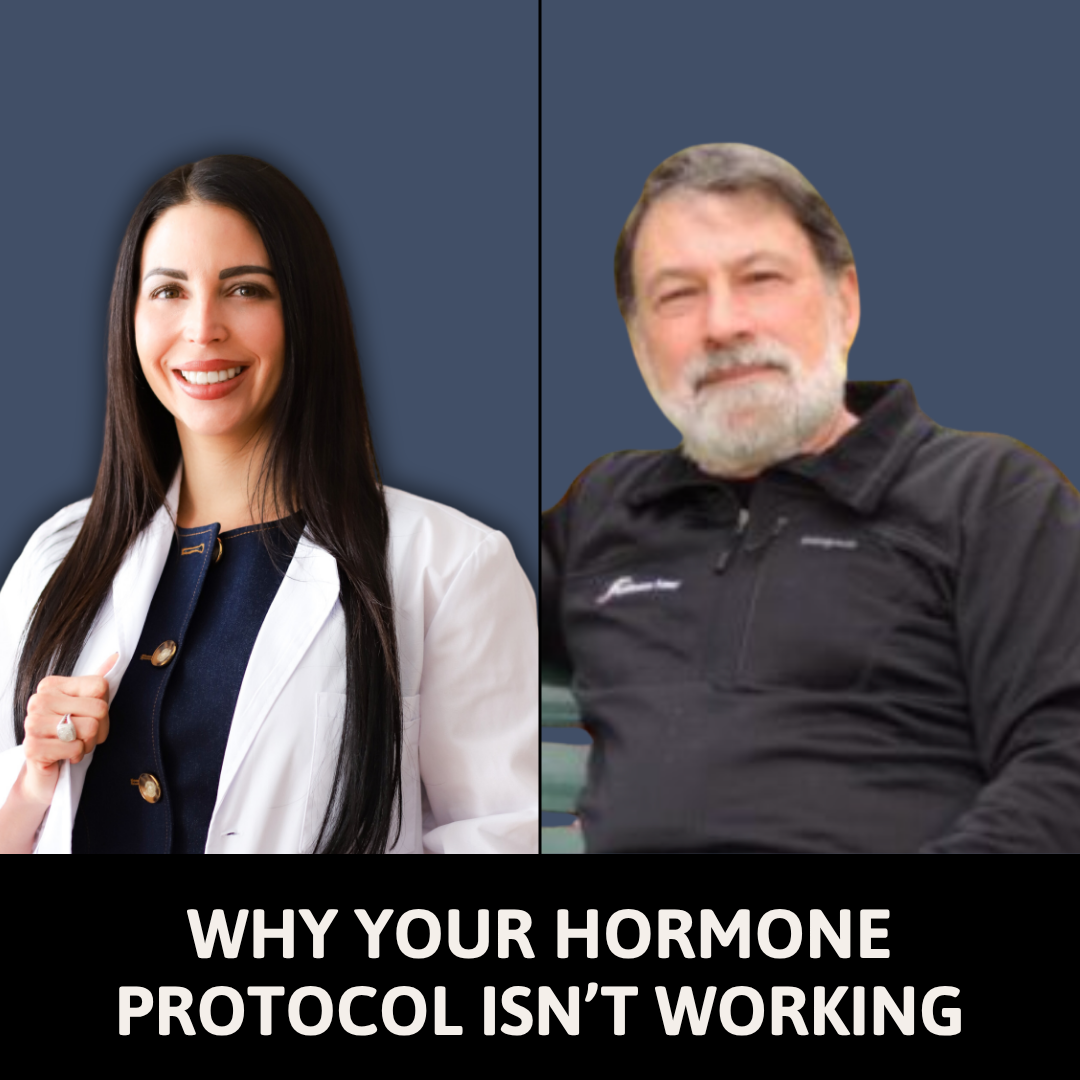
What happens when you’re doing all the “right” things for your hormones and health, but you still don’t feel better? In this episode, I sit down with Dr. Neil Nathan to explore why underlying factors like mold, Lyme disease, inflammation, nervous system dysregulation, and detoxification challenges may complicate treatment.
We also talk about why some patients react unexpectedly to hormones or supplements, how Dr. Nathan approaches complex chronic illness, and why looking beyond the obvious diagnosis can sometimes change the conversation.
Topics We Cover in This Episode:
- Why hormone protocols don’t always work as expected
- How mold and Lyme may affect the immune system
- Why “detox” isn’t a one-size-fits-all approach
- What persistent or unusual symptoms may be telling you
- How inflammation can present differently from person to person
- What cytokine testing can reveal
- Why environmental exposure matters
- When it may be time to look deeper
If you’ve experienced persistent symptoms, unexpected reactions to treatment, or the frustration of doing everything “right” and still not feeling better, this is a conversation you’ll want to hear.
Resources:
Connect with Dr. Neil Nathan: https://neilnathanmd.com/
Order Dr. Cassie’s Book ‘Fix Your Gut, Fix Your Hormones’: https://guthormonefix.com/
Use code LISTEN10 for 10 % off your order on shopmodernendocrine.com
Additional Resources:
Check out the website
Follow Cassie on Instagram
Follow Cassie on Facebook
Follow Cassie on YouTube
Follow Cassie on TikTok
Disclaimer:
The information presented including any materials discussed, referenced, or linked within this podcast are for general educational purposes only, not the practice of medicine.
No doctor-patient relationship is formed from you listening to this podcast or utilizing any of the information provided.
I am a doctor, but I am not talking to you as your doctor. The information provided is not intended to diagnose or treat health problems or take the place of the professional medical care provided by your doctor.
If you are experiencing any health problems, including problems you believe have been touched upon in any respect within this podcast, you should consult your doctor about the problems without delay. You may ask your doctor whether he or she believes the information I have provided would be helpful to you, but you should still consult your doctor immediately and follow his or her medical advice as your treating physician.
I’m just here to provide you with basic knowledge about the issues we discuss so you are more aware of them and can better discuss them with your doctor.
Join me on the next episode as we continue our journey.
Transcript
Welcome back to hormones, metabolism and you. I’m so glad you’re here. Today’s episode is for anyone who feels like they’re doing all the right things for their hormones, metabolism, energy, and overall health, but still not seeing the progress they expected. If you listen to my recent conversation with Doctor Eric Boskovich on Cell Danger Response, this episode is a powerful continuation of that discussion. In fact, the person who developed the cell danger response theory wrote the foreword to the first edition of today’s guest book, toxic, which makes this conversation especially relevant as we explore why healing can feel so complex for so many patients. Joining me today is Doctor Neil Nathan, a pioneer in functional and integrative medicine with more than 50 years of clinical experience. He’s widely respected for his work in complex chronic illness and for helping patients and practitioners better understand conditions that are often overlooked or misunderstood, including chronic fatigue syndrome, Lyme disease, Bartonella mold toxicity, mast cell activation syndrome, multiple chemical sensitivities, and long Covid. What makes this conversation especially important for this audience is that Doctor Nathan’s work helps explain why hormone and metabolism symptoms don’t always improve just because someone is following the right protocol. Sometimes deeper issues like toxins, infections, nervous system hypersensitivity, or impaired detoxification can keep the body stuck and reactive.
In this episode, we’re talking about why hormone protocols don’t always work, why detoxification may need to come first, why some patients react to even low dose supplements or hormone support, and why going slower is often the key to finally moving forward in some patients. Doctor Nathan is also the author of toxic and the newly released Toxic Second Edition, which expands on mold and Lyme diagnoses, detoxing strategies, Environmental toxins and Covid related chronic illnesses. This is such an eye opening conversation. I think it’s going to resonate with so many of you. So let’s get into it. Today, we’re talking about something that I think will resonate with so many of you. What happens when hormone protocols aren’t working the way you expected and why? The deeper root cause may not be hormones alone. I’m joined by Doctor Neil Nathan, a physician and author of toxic and the newly released second edition Toxic Second Edition Heal your Body from mold toxicity, Lyme disease, multiple chemical sensitivities, and chronic environmental illness. His work focuses on complex chronic illnesses, including mold toxicity, Lyme disease, chemical sensitivities, and the patients who often feel like they’ve tried everything and still aren’t getting better. Doctor Nathan, welcome. I’m so glad you’re here.
Oh, thanks for having me.
So I know we were chatting before this started very interestingly, used to work in Springfield, Missouri, where I was born. But I know you’ve been doing this for a little bit of time now. Tell everyone kind of give everyone like a 2 or 3 minute synopsis of your career. If you can do that and kind of like what you’re doing now as far as seeing patients, because I think it’s important for people to know a little bit about your background and that you’re not just making this up on Instagram, right?
I don’t really go on Instagram, actually.
You don’t you don’t even have an account. I’ve looked you up.
I actually do have an account, but I got so frustrated with its complexity that I, I’m a dinosaur, so I kind of gave up on it. I went to medical school with the intention of becoming a healer, and I was quite disappointed that after some time in medical school, I realized that’s not what they were going to teach me. They were going to teach me to be a medical technician, a good one. But I mean, I went to the University of Chicago, which is considered, you know, a top medical school. But that didn’t change the fact that I didn’t think that they encompassed what I wanted to learn to help people optimally. So when I left medical school, I began to study passionately all kinds of other healing modalities that I thought I can incorporate to help people even better. So I studied nutrition in a way that we were never taught. In medical school. I studied biochemistry, I studied acupuncture, I studied emotional release techniques, I studied hypnosis, and the list is actually larger than that. And my goal was to try to help, if I could, every single person who walked into my office. Now I realized that that’s a little bit delusional. But honestly, 55 years later, it’s still my goal. So I think it’s a great goal. The fact that I may not have achieved it is okay with me, because I’ve learned a lot over this period of time, so that over the years, my practice has attracted those people who kind of fell through the cracks, where they just weren’t getting the help they needed from other physicians or university centers. They just weren’t getting a diagnosis that allowed them to get better. So I kind of became a medical detective. So that’s a very short version of how I got where I am right now.
Yeah, I think that that’s very fascinating because to your point, I went to medical school to be a healer as well. And I don’t even know that I want to say they taught me how to be a technician. I think now they’re teaching you how to put people in a box and then prescribe them a drug for their illness and then move on. But the problem is those drugs have side effects and those illnesses and the root cause that cause those illnesses, cause additional illnesses. And then, yes, people end up in this big spiral out of control circle and the traditional medical system fails them and they just end up really, really sick. And so I see sicker and sicker people in my practice as well that are rightfully very frustrated with the medical system. And unfortunately, I feel like it’s getting worse, not better.
I agree with everything you said.
Yeah. So I love that you also have all these modalities that you’ve studied. I tell my husband all the time, I want to learn acupuncture. And he’s like, in what time or, you know, world would you do that? But I think it’s very fascinating. We do a lot of nutrition at our office at Modern Endocrine, a lot of nutritional counseling, and just talking about how food is actually healing and important for the body. I hated biochemistry, but good for you. Um, emotional release and things like that, I think are also very powerful. So I love that you have just this like full body mentality of how to help someone. And so I’m sure that you have helped probably tens of thousands of people over the years. And I think that’s fascinating. And I, I told you, I have a copy of your first book and then your second book. So if you’re watching on YouTube, this is his first book, which I was actually given by a friend. I was telling him like three years ago when I first got into functional medicine. And then I was lucky enough to receive his second book in the mail recently. And so I do read this and look at this a lot. And I think, you know, maybe this is what we need to be teaching in medical school now and nurse practitioner school and just medicine in general. But we’ll talk about that. Right?
Well, I agree, I taught in medical school for 11 years at the at the University of Minnesota, and we had it back then. In addition to conventional medicine, I taught one of the first courses in holistic medicine. This was late 70s early 80s, and it was one of the best attended elective courses in the school. I tried to make it as experiential as I could. So we brought in Indian medicine men and did shamanic healing. We did hypnosis for the whole group. We. We tried to help the students understand that healing was a much bigger process than what they were going to get taught. And it was kind of gratifying work. A lot of those medical students went on to study what is now called functional or integrative medicine. And and they’re in practicing it for years.
Yeah, I think we need more of that in medical school, more of the root cause approach for sure. So I would love to start with like big picture. Most of the people in my audience are dealing with things like fatigue and metabolic resistance or, you know, difficult weight gain, thyroid symptoms. And a lot of them feel like they’re doing everything right. You know, they’re listening to podcasts like this. They’re trying to actually get better, but something just isn’t clicking with a lot of people today. What are the biggest missed root causes behind symptoms, especially that women have in perimenopause and menopause that often get labeled as hormonal or metabolic? But you think, man, something else could be going on. Like what are some of those big missed root causes?
So I’m going to answer that question in two ways. The most direct answer is mold toxicity. And Lyme disease with its co-infections, are two of the most common conditions that aren’t really looked for in conventional medicine, and they’re very common. It is estimated that there are over 10 million people in this country right now suffering with mold toxicity. Most have no idea there’s another additional 10 million people with Lyme disease and co-infections that are not getting diagnosed. So those are common, treatable things that people should be looking for. But I want to expand that answer a little bit in that mold. And Lyme will trigger in our patients limbic, vagal and mast cell issues, which will prevent them from responding normally to the things that would ordinarily help them. So I just want this answer to be as comprehensive as I can, because it isn’t just mold and Lyme, which directly impact the pituitary’s ability to regulate all of our hormones, but they also trigger limbic dysfunction, vagal nerve dysfunction, mast cell activation, which when present, won’t allow patients to To respond normally to what otherwise would be a perfect treatment. So those are, I would call the biggies.
Yeah. I would say that in my clinical practice, when I get people who don’t respond pretty normally to the things that we do and I say the things we do, we do a little more root cause analysis. I mean, we look at gut, we look at nutrition, we look at sleep, look at relationships, self-talk, you know, but light therapy. But if we put people in this program of like, hey, you need to see the sunlight in the morning and you need to get eight hours of sleep and you need to eat whole nutrient rich, dense foods and you need to move your body. And we do a pretty comprehensive lab workup. And if you have hormones that are deficient, we replace them. If people don’t start getting better in 90 days, almost always I’m like, yep, you either have Lyme or you have mold and we need to address that. So I would agree with that. Do you think that Lyme and mold are more common these days, or did we just not know about it in the past? Like, is it a combination of this toxic environment we’re living in? Plus we’re not sleeping, plus we’re eating bad food. Like what is driving all of this? Why are there 20 million people that have this that don’t know?
So it’s not new. Mold toxicity was written about in the Bible. Okay. In Leviticus, there’s a long section on if you’re living in a moldy environment, you need to get out of that environment. And there’s elaborate instructions about if you aren’t getting better, then eventually you burn the building down because it’s not going to be livable. But I think that we are seeing epidemics of not just mold toxicity and Lyme, but autism, cancer, chronic fatigue, fibromyalgia, Alzheimer’s, ALS, Parkinson’s. There’s clear medical data that these conditions are increasing exponentially. Things are just getting worse. And I do think it’s in our environment. I think that the environment that we live in is increasingly toxic in a bunch of different ways. We know, for example, that there are 350,000 new chemicals in the last 70 years. The vast majority of which have never been tested for safety in human beings. We’re being exposed to electromagnetic fields in amounts that have never existed before in human history. And what I think the underlying understanding of that is all of this has to do with our immune system. So if you have a robust immune system, you can get a tick bite and be okay for a long time. If you have a robust immune system, you could be living in a moldy environment and have little to no symptoms. But if your immune system takes a hit now, for many people that hit was Covid, but for other people, any severe infection, pregnancy, menopause, any emotional upheaval, a surgical procedure, if the immune system takes that hit, it loses containment. And what’s already in our body goes to town and we are off to the races getting sicker and sicker. So a lot of this has to do with these increasing amounts of toxins. And EMF were being exposed to is weakening our immune system. It’s overloading our liver, whose job it is to process all these toxins. So I do think we’re seeing more and more because our bodies are just struggling to deal with the environment that we live in.
Yeah, I completely agree. I also think, you know, in writing my book, I learned a lot about how our hormones, especially as women are estrogen and progesterone and testosterone, help regulate our gut, our microbiome, and our estrobolome. And when we lose those hormones, we have a lot of shifting in those hormones, whether that be age, whether it be chronic stress, whether it be infections, Covid medications, right birth control pills, etc. when we start to lose that microbiome diversity in our gut, it destroys our immune system, which makes sense to me because I have women tell me all the time, man, I was healthy my whole life. And then this one event happens. And then now I have all of these symptoms, all these issues, or they all of a sudden have mold. And I have a lot of patients who have developed mold issues in their late 40s, early 50s as their hormones are transitioning and their husbands get so mad because they’re like, we’ve lived in this house for ten years, we’re not burning the house down. We’re not moving. You know, I live here and I’m fine. And I think that they’re missing the connection of like, well, your wife was fine, too, until her immune system got destroyed. And now she literally is not going to be able to get better in the environment that she is in. And so I think it’s just it’s, it’s interesting for sure.
Yeah. Our patients tend to get gaslight lighted by both the medical profession and their families. If that husband that you’re referring to had a robust immune system, then he could be perfectly fine in that environment. But what he’s not understanding is it’s not just about him needs to understand that other people have different biochemistries and genetics, and they’re going to be affected differently in the same environment. We see that a lot. We see kids in schools where maybe anywhere from 10 to 30% of kids in a particular classroom are affected, and everyone goes, oh, but there’s 70 or 80% of these kids are fine. The implication is there’s something wrong with you or it’s in your head, or you’re making this up. And that’s not happening at all. It’s just we have different responses to our the stressors in our environment. And it’s a shame that everyone can’t just honor that and go, yep, I’m fine, but let’s figure out why you’re not right.
I completely agree. So if someone’s listening to this and they say, you know, I’m doing everything right, but I still don’t feel better. The first thing you would think about would be mold or Lyme. Is there one versus the other or what would you say to that?
I would my first thing to do would be to take a good history to really dig into it. Have you had water damage to the building that you’re in? So first currently, like, are you getting exposed? Do you smell mold anywhere? Do you see mold anywhere? Is there dampness in parts of the house that just you can’t seem to get get a handle on? And maybe that happened to you when you were younger? Did you ever live in a moldy basement? So at any point, if you were exposed, it could be in your body and the body’s not able to get rid of it. And then, as I said, once that immune system takes a hit. Now it comes full fourth full blossomed as a problem. Okay. So have you been bitten by a tick? Do you live in a tick endemic area? Those are. Have you ever seen a bull’s eye rash on you? Or ever gotten an insect bite that looked like weird to you? I would generally say that I see mold toxicity more than I do line in your area of the country. I don’t think Lyme is quite as prominent as it is in other parts of the country.
You know, when I lived in Missouri and was practicing there, the state of Missouri kept records of physicians who would say, this patient has Lyme, and they would get at least 300 every six months. And it wasn’t a mandatory report. So these people were going out of their way to tell the state, hey, I think I’m saying lime. The odd thing was, the infectious disease specialist said, no, we have no lime in the state. You can’t have it. That’s not even passable. So there’s this disconnect between what physicians were reporting to the state Department of Health and what infectious disease people were saying. And the infectious disease folks had a lot of clout. So they would basically convince the docs like, don’t ask me to work up someone for lime. He couldn’t possibly have it. We don’t have it here. So I traded a lot of lime in Missouri when some of my colleagues were being told it doesn’t exist here, and Missouri is just the next state. Over to you. So I think you’re probably seeing the same thing.
Yeah, I think that’s a couple of things that’s interesting. You know, you bring up, you know, infectious disease says, oh, that’s not here. So that that can’t be the case. I get a lot of pushback with GI doctors here for the same thing. You know, when people have a lot of severe GI upset acid reflux, maybe blood in their stool, blood on a GI map. Just lots of different things with GI maps. And we and I get a lot of pushback from GI doctors. Oh, well, you know, that’s ridiculous. Functional medicine. Stool testing isn’t a real thing. I’m not going to do this workup. And it’s frustrating because the patient kind of gets stuck in the middle of it. You as the provider know something’s going on, and that’s the root cause you need to address with this patient to make them better. So I think it’s interesting that infectious disease gave you that pushback when you knew there was a bunch of Lyme in Missouri. Tell listeners that are listening, where are the Lyme areas in the United States? So like what states or what parts of the US have a lot of Lyme so that people know.
Okay, the hotbeds Lyme is present in every state in the country, in every country in the world. The hotbeds are first in New England. When it first appeared, the Minnesota Wisconsin area, the Pacific Northwest. There’s more in those areas, but it’s everywhere. I don’t think it helps to think that I’m safe because I’m not in a horrific Lyme endemic area, you know? And your comment about the GI stuff is, I think, very appropriate. I find that the GI folks, the specialists, and I hate to say this, but they make their money by doing endoscopies and colonoscopies. That’s where the money is. It’s not in an office visit. So yeah, they’re a way of approaching all GI issues is I’ll start with an egd and a colonoscopy. That’s my starting point. And they’re not either trained or don’t appreciate the subtleties that we are looking at in functional medicine, where we can run tests and find, oh, there’s a huge biome imbalance and there’s mold and candida in the gut, or there’s overgrowth of Klebsiella or other bacterial species that we can treat and work with. But it doesn’t seem like there’s a disconnect there. For whatever reason, the specialists have their own approach, which does not include even how we look at it, which we know is extremely helpful in helping people really get their health back.
Yeah, with all due respect, I have never been more frustrated with a group of physicians than I am with GI doctors. I mean, I have people in Oklahoma City, GI doctors that tell patients I’m crazy, I’m taking their money. I’m not helping them. And it’s because, to your point, the only way they make money is to scope someone. And I had a conversation with one of them and I said, you do realize the only way you help someone is when you scope them and there’s already a problem, right? You find a cancer, there’s already an issue. I’m actually trying to help people before that. Like I want them to not have a cancer, not need a colonoscopy, you know, not need all these things. And that’s what’s so frustrating to me is there are real things you can see on functional medicine testing that actually help people. I have thousands of people who have written reviews and will tell you that. And it’s just frustrating when GI doctors, like if you don’t understand it as a provider, that’s fine. There are things I don’t understand. I don’t call anyone’s baby ugly. I just am like, hey, I don’t get that. Maybe you should go to that provider and have them, you know, like mold and Lyme. I know enough to say, yes, you probably have mold or Lyme. But then a lot of times I send those people for further testing like, hey, it sounds like you have Lyme. I don’t really know how to interpret this or how to treat it. So let me send you to somebody who does, but I never am like, oh my gosh, Lyme is not a real thing.
And so I think it’s just frustrating because patients get stuck in the middle of that. And I had a lady recently who was in her late 30s, and she was having all these weird GI upset. Her labs looked very strange. She was having some weight loss. And so I did a GI map and her calprotectin level was extremely high. She had blood in her stool and she had a ton of fusobacterium. And so I was worried that she might have cancer. And so I sent her to a GI doctor in Oklahoma City. They refused to scope her, wouldn’t do it. They were like, nope, she’s too young. I sent her to another one, same thing. And so finally I called the one and I was like, this lady has lost her tremendous amount of weight. Now she’s anemic. So finally, once she’s anemic, like six months later, they’re like, okay, maybe we’ll scope her. It was this whole thing. And guess what? She had colon cancer and they were telling her to come back in 12 years and like, refusing to scope her, telling her that I was crazy and I was so mad because it took like 6 or 7 months for them to actually scope her and find the cancer. Thankfully, it was still stage one, but I just, I don’t know, it’s very frustrating to me. It’s like just, I don’t know. Anyways, I digress, but.
Many specialists focus on only the most severe things and the subtleties aren’t even really part of their training. I have a pet peeve I, I share your concerns with gastroenterologists that psychiatrists, to me are in the same pet peeve category where many psychiatrists are quick to prescribe medications, which are generally band aids, but they not looking for what are the biochemical shifts in the body? Root causes that are creating that. So there are countless patients with mold toxicity and Lyme disease and Bartonella that have a lot of psychological issues which are cured when we cure the cause. And they don’t need an antidepressant and they don’t need a benzodiazepine as their primary treatment, they need to have somebody dig into it and figure out what is messing with my neurotransmitters, what is causing this? Mother sorry, mother pet peeve.
No, I completely agree. And a lot of times it can be gut related as well. So I also agree with that if somebody is listening to this. So now we kind of talked about Lyme. Where is mold common? Can it be anywhere? Is it more in you know, I think about in Oklahoma, we have a lot of mold because it’s very humid. Obviously, places like Florida that get a lot of rain. But can you have mold anywhere or is there like a hotbed for mold?
Well, the two top states in the country for mold are Texas and Florida. That is true.
Texas and Florida.
But again, I live in the Pacific Northwest. We have a lot of rain up here. There is no place on earth that is safe from mold. A lot of people think, okay, I’m having trouble finding a safe place to live. Wherever they are. I’m going to go to New Mexico or Arizona. Mhm. There’s plenty of mold in New Mexico and Arizona. So, I mean, this is a whole huge topic here, but any place in which it rains and a building becomes damaged by the water damage, that is the fertile ground by which mold grows and by which people get sick. Yeah, I don’t want to scare your audience, but federal agencies estimate that at least 40% of all homes have significant mold in them. So now you’ve got a robust immune system. You can probably handle it. But if your immune system takes that hit, then really bad can happen to you. And, and the mold and Lyme patients are typically when they get it full blast, they’re really sick.
I guess this is why we were supposed to live like in tents in the wilderness, huh? Then you can’t have mold in an environment that you’re breathing in. So interestingly, though, you said something just a few minutes ago. You said something about if you smell mold or you feel, you know, things as far as like the home that you’re living in, I think it’s important for people if you’re listening to this, to really take that. And so the reason I say this is I, for instance, like when you as a person, if you are in an environment and you’re like, man, when I’m in this environment, it just something doesn’t feel right or it smells weird, or you should listen to that intuition. And the reason I say that is last year for my birthday, my husband took me to Hawaii. Beautiful place. We were in Kauai. We went to this hotel, wonderful hotel, but it had been renovated and the first day we got there, I said to my husband, I just don’t feel good. Like something about this. Like, I don’t feel well since we’ve been here. And he’s like, oh, we’re traveling. I’m like, okay. But it was kind of like mildewy smelling musty smelling to me. And my husband was like, no, I think it’s fine. And you know, we’re on this beach, we’re on it.
And the longer we were there, the worst. I felt like then the next day, my head started throbbing and I was tingling and like. And so I said something to the people at the front desk and they were like, yeah, we actually did have a big renovation about six months ago, we got this huge rainstorm. There was a lot of flooding, and the side of the hotel that you’re in was definitely renovated. And I was like, I swear to you, this room is full of mold. That’s why I told my husband. I was like, I just felt, you know, and then when they move you, then I felt much better. And so I think it’s important that people also like, don’t let somebody gaslight you or tell you, hey, this, you know, and my husband didn’t feel bad because he isn’t a great, great immune system. And I had actually just had surgery, like lots of things. But I think also you have to listen to your own body. And like, if you just go into an environment and you don’t feel well, you should take that as a, you know, I tell patients, symptoms are kind of little gifts. Don’t just brush those off. Like actually listen to yourself and maybe move into a different environment, right?
One of our messages is clearly today to everyone out there is trust your experience. Don’t let a medical person or anyone else talk you out of what you are experiencing. Don’t allow yourself to get gaslighted by someone who doesn’t understand. That is the single probably most important thing we can tell everyone is if you are not well, then dig deeper. Find someone who can help you. And again, it may not be in conventional medicine, which is great for all kinds of things, but for some of these more complicated issues, you probably want to find someone who’s got some training in functional or integrative medicine.
So if somebody is listening and they’re like, I have a lot of people who reach out to me and say, I’m on this hormone protocol. And it always worked. And then it stopped working. Or I started a hormone protocol and it never worked. Or I started a hormone protocol, and I’m getting all these weird side effects from the hormones that they say are backwards. Like progesterone is amping me up instead of calming me down. These are all signs too, that maybe somebody has something like a deeper root cause issue going on.
Yes, absolutely.
I think the other thing I want to ask you about, Doctor Nathan, is the foundation of detoxification, because a lot of people talk about detoxification somewhat not correctly on social media, but the word gets constantly used online. And it’s not always a helpful or medically grounded way. So if we’re talking about detoxification, what do you actually mean from a clinical perspective? If we’re talking about detoxification, if somebody wants to start trying to detoxify themselves from anything mold, Lyme heavy metals first, obviously we have to remove ourselves from that environment. I don’t think some people realize that, but you literally have to leave that environment or you’re not going to get better. But what else? Like how would you describe And, you know, how would somebody go about doing that?
Well, I mean, you’re right. It’s very complicated. And the word is, I don’t know, maybe a buzzword. So I think it’s lost some of its meaning and it’s lost some of its specificity. So let’s say we have mold toxicity. One of the things that messes with the body’s ability to detoxify is mold toxicity. I mean, mold interferes with the body’s ability, the kidneys and the liver to process mold so that the best way to improve the body’s ability to detoxify the mold is to treat the mold. So yes, we can do other things as well. We need to look at the organs of detoxification, the liver, the gut, the kidneys, the skin, the lymphatic system, the lungs. Looking at it from a perspective of are they working optimally? Is my liver able to handle the load that’s working on it and my kidneys able to do that. And then you want to be just specific because there are so many supplements out there that will say on the bottle, good for detoxification. The answer is yes, but under what specific circumstances? So you could be taking 20 supplements that are supposedly good for detoxification, that aren’t really specific for what you’ve got. So forgive me, you kind of have to work with someone who knows something about this so that the supplements that you are taking will be as specific and useful for you as possible.
And sometimes people can detoxify too aggressively as well. And I think that’s the other problem is if you’re listening to somebody online or a social media guru who’s selling you a detox bundle and they aggressively detox you depending on what you have, and correct me if I’m wrong, but if you detox too quickly, that can cause a lot of issues as well. Right. Can you tell people about that?
Absolutely. One of the most important detoxifying substances is glutathione. And glutathione does indeed improve the body’s ability to detoxify. But as you’re saying, if you had mold toxicity, I would say that most of my patients with mold toxicity and I treat some of the sicker folks. Admittedly, if they took glutathione, it would make them worse. What it’s doing is it’s mobilizing mold toxin faster than they can process it and literally making them more toxic. So you can’t just take things that are good for detoxification as a general rule. If you’re wanting to detoxify, you want to go slow, you want to go low, you want to ease it into your body. If your body can handle it at all. Again, just to repeat, in my patients, probably two thirds can’t take glutathione without getting into trouble. So no, you don’t want to jump into something willy nilly. And again, trust your response. If you are taking something that’s supposed to help you feel better and it’s not, then that’s a terrific piece of information for you of, well, whatever you’re doing, not the right approach. And if you can look at it with enough detail, it’ll actually help you understand what it is you might have.
So with that being said, let me transition into asking you this, because this is the question I get from everyone. So if I have Lyme or I have mold or I have heavy metals, how long will it take for me to get better?
Well, there’s a different answer for all of those. As a general rule, most people with mold toxicity take at least a year, sometimes longer, to get the mold completely out of their body, depending on their toxic load of heavy metals. I could give the same answer depending on which aspect of Lyme they have. Be it Lyme itself or Bartonella or Babesia or other co-infections. Again, we’re talking at least a year. So this is not a quick fix. If you have these conditions, know that you’re in for the long haul here. You need to be patient with your body. It’s not going to come out of your body very quickly. But take home message. Everything we’re talking about today is treatable. So yes, we can treat this successfully, but you need to be patient.
So besides the fact of what we talked about as far as like, hey, I’m doing everything right, but I’m not getting better or I’m taking hormone protocols. It’s not working. What are some of the symptoms that are most commonly dismissed but deserve a deeper look when we’re talking about things like mold, Lyme heavy metals, like what are the symptoms that people get gaslit with that could actually be from those conditions?
Well, the answer is it’s a load of symptoms, which is the reason they get gaslit is they’re describing fatigue, cognitive impairment, difficulties with focus, memory concentration, anxiety, depression, and increased sensitivity to things like light and sound and smells and chemicals, peripheral neuropathy, shortness of breath, air hunger, joint pain, muscle pain, cramps, fasciculations, visual changes, and issues of every type. Headaches. I can go on. The problem is many of our patients have all of these. And when we begin to provide this long list of what they’re struggling with, the first thing some physicians go, oh, nobody can have all of those. This has got to be in your head. And the truth is. Oh, no, you could have all of that. The underlying thread of all of these conditions is they create an inflammatory response in the body that is global. The whole body becomes inflamed, and the particular organs that are the most susceptible in that person are the ones that will experience it most. So you could have four people in the same moldy environment with four somewhat different symptomatic presentations, because they’re all different biochemically and genetically.
Yeah, I think that’s really important for people to understand. Like we start with cell membrane health. When we see people at modern endocrine and it starts with inflammation. You know, I write a lot about in my book, I think inflammation is kind of the root cause of all evil. It’s the root cause of disease. It’s why we age, and it’s ultimately why we die when we’re inflamed. Whatever is causing the inflammation, mold, Lyme. Lack of sleep, heavy metals, chemicals, whatever. When we’re inflamed, literally, our cell membranes can’t work properly and things don’t move across cell membranes. Hormones don’t move, molecules aren’t triggered. You know, you loved biochemistry, all those things that are supposed to happen from a biochemical standpoint. Our cell membranes are made of lipid bilayers, which become very stiff and rigid when we’re inflamed. And so then we can’t pass messages across cells. And, you know, I tell people, it’s kind of like if you have an army that’s trying to invade a country. Imagine if that army, every single soldier is just working on its own, and none of them can talk to each other. How well is that invasion going to go? It’s not like. And so if your body is literally trying to function like that, where cells can’t talk to each other, hormones can’t pass signals, nobody knows what’s going on because there’s so much chaos, which is inflammation. We’re not going to get better. And in fact, we’re probably going to get worse. And so, you know, and then people try to dump other things in there, like you said, glutathione and things to try to make it better. And again, if the foundational layer of cell membrane health doesn’t work, I mean, we’re we’re in trouble. And I think that’s why so many people are just getting sicker. We keep adding all these different layers, which cause inflammation and cause people, you know, to not be able to heal. And it’s really frustrating because traditional medicine doesn’t teach us anything about any of that.
Yeah, I agree. In fact, my newest book, which I’ve just written might come out next year, is exactly about this. It’s about inflammation as the underlying component of almost all chronic illness, particularly from the perspective of learning, which tests help you understand what kind of inflammation a particular person has. Because we use this global word inflammation and people think, oh, it’s all the same thing. The image of inflammation would be like a
cellulitis, where you had an inflamed, hot red, swollen area of skin. That’s how we’re all trained to think about it. But on a cellular level, it’s a much more complicated biochemical process. And all the things we’re talking about cause different kinds of inflammation. And so they need to be diagnosed differently and treated differently in order to really get people well.
Yeah, I agree, and that’s kind of the rabbit hole I got down when I was writing my book is I was just perplexed at all the different ways you can become inflamed in your gut, like things you think negative thoughts can actually trigger vagal responses, which can change the immune system of your gut. And then you can get bacterial overgrowth or yeast overgrowth, which then starts this cascade of effects, which changes your hormone production, increases insulin, increases cortisol, downregulates, estrogen, and progesterone. It’s just crazy how just thoughts can start to affect your body. Not to mention, then we throw in a little bit of lack of sleep because we’re living in this crazy world where we don’t sleep. Then we throw in some fluorescent lights, we’re not getting sunlight, and then we eat chemicals, and it’s like the death by a thousand cuts. And then we wonder why people are so sick. Kids are so sick, and they just can’t get any answers. And it’s because again, in medical school, they teach us to do, like you said, is be technicians. And it’s technicians of pushing prescription medications because I hate to say it, but pharmaceutical companies a lot of times are what’s funding medical schools, right? Or at least trying to. And so it’s just, it’s kind of sad. But I’m thankful that we have people like you who are trying to teach patients to be advocates for themselves and teach providers how to actually diagnose and treat people and make them better.
Well, in conventional medical thinking, there are two tests for inflammation. There’s a CRP and a set rate. And so I’ve had so many patients who saw a physician who did those tests. They’re normal. And it says, well, you’re not inflamed because these tests are normal. And those are only two week tests for inflammation. There’s we have now dozens and dozens of new ways of measuring inflammation. We can actually measure cytokines now, which are literally the materials the immune system makes to make us inflamed in order. It’s not their job isn’t to make us inflamed. That’s a side effect. Their job is to fight off bacterial and viral invaders by putting these cytokines out, which will kill them. However, what happens is now they’re putting out these cytokines and doesn’t know how to stop making them. And that’s so we can measure these things now. But it’s not done conventionally. It’s not something that people look at.
What are some of these tests tell me besides. So we look at CRP, we look at ESR. I like uric acid. I like to look at insulin. I look, but tell me some of these tests, like how do you measure cytokines? Or give me a few of these tests? I can’t wait to read this book that you can measure.
Okay. My favorite is a test developed by Bruce Patterson, and he’s got a lab called Radiance Laboratory, and they have a panel, which is a 14 panel cytokine test, meaning it measures 14 different cytokines. And what he’s he’s published a bunch of papers showing that you can diagnose with precision long haul Covid. You can diagnose with precision Lyme disease because they have different patterns on the cytokines. Now, the symptoms may be the same. The symptoms of long haul Covid and Lyme and mold can be very, very similar from patient to patient. But the testing shows that the cytokines are unique for long haul Covid for Lyme and unique again for mold. So I find that test extremely helpful in terms of being able to tell me, what is this immune system fighting right now by the kinds of cytokines it’s making to engender this fight? So that’s my favorite of all the tests that are out there right now.
Awesome. So Radiance Labs. Okay. I can’t wait to read this book. I think that will be very helpful. So what message would you give to listeners who’ve listened to this and feel like they’ve tried everything and they still don’t have answers, and now maybe they feel a little bit better, but are are somewhat overwhelmed? Do you have like a take home message for them?
I do, which is look harder. And as we’re seeing, the most likely place that you’re going to get your answers is at least run some basic tests for mold and for Lyme. I mean, that’s basic. There’s a simple urine test which measures the mold toxins called mycotoxins in our urine. It’s very helpful because if you are peeing out mycotoxins, they’re in your body. It’s not rocket science. So measuring urine mycotoxins is an extremely accurate way to not only know that it’s there, but also knowing which mycotoxins are there, because then we can get really specific about which binders we’re going to use to pull the mycotoxins out of your body. So it’s a blueprint for what we’re going to do next.
Is that something that anyone can order like a mycotoxin in their urine, or is that something they have to go to a provider and get. Does it come from a special lab.
There are three different labs, but it has to be ordered by a medical practitioner. You can’t go and get it on your own. The three labs are real time mosaic and vibrant health. Any positive test from any of those labs will tell you what’s going on. Having done tens of thousands of these with all of these different labs, including comparing one to another, I find the real time lab the most accurate for those people who are on Medicare. It’s free.
The real time. The real time lab.
Yep.
Okay.
Yeah. Medicare will cover that test. So it’s very simply you collect a first morning urine and you send it in and then we can know with precision. Okay, you do have mold toxicity and I know which molds are there. So I actually know how to treat it. But as you mentioned, I want to emphasize that if you have mold toxicity, the number one. First thing that has to happen is you need to get your home or workplace evaluated. Because if you are living in mold or you’re working in mold, you can’t get better even if you do all the right treatment. So getting out of a moldy environment, getting into a safer environment is absolutely step one.
So sometimes I have patients who tell me, okay, I’ve done this mosaic or this mycotoxin test in my urine. And it came back that I had high mycotoxins, but I went to see another provider and they said, well, some of those are just like, I don’t know, it’ll say on there, like, this should not be used to diagnose or treat mold disorders. And so what is your, I guess, rebuttal to that? Because, because my thought is if you’re peeing out mycotoxins, that’s not a good thing. But but you tell me.
I’m with, I’m with you. And I’ve been tens of thousands of these tests on patients. I find them accurate. There are people who say, oh no, you can get it from the food that you eat. And if you see it in your urine, it’s from food. It’s not from any exposure. No, oddly, nobody’s really studied that. The only study that I’ve ever done was one that I did with the Great Plains Lab a bunch of years ago. Well, it was a small study. We meant to expand it, but the person doing it with me left the company, and that didn’t happen. We took eight patients, not a huge number with mold toxicity, and we had them avoid eating all foods that are known to potentially contain some mold for ten days. We measured their urine mycotoxin level. Then we had them pig out on those foods for ten days and again measure their urine mycotoxin levels. In seven of the eight patients, their urine mycotoxin levels went down. Eating. Supposedly potentially moldy food and one patient. They had a slight increase in only one toxin, which was ochratoxin. Now that study needs to be repeated on a much larger scale to make it clearer, but in my experience, it is buildings that are moldy that are really causing people to be sick. And what what we eat has a minimal effect on us. There are specifically foods that are moldy than others. For example, the government does regulate the amount of mold in food generally. But one industry that is exempt from that is coffee. So coffee can be very moldy and you don’t know what you’re drinking, which is why many of you out there are seeing advertisements for mold free coffee, bulletproof coffee, and a whole bunch of others are out on the market now because they’re going to great lengths to be sure that mold and other toxins are not in the coffee that you’re drinking all day long, and that you can get some through coffee. But mostly it’s the buildings that you’re exposed to that have become water damaged.
Okay. So if you have urine mycotoxins, you should probably find someone to help you fix that. If somebody gets. Oh, and by the way, my favorite mold proof coffee is happy gut. I don’t know if you’ve heard of Happy Gut, but Doctor Padre, he’s in Miami. Very nice guy. He’s a gut health expert. He has a mold free coffee that I really like. If patients get your book, can they go through this book and kind of figure out ways to detox? Or is this mostly for medical providers?
Well, it’s written for both. And patients can learn what they need to do to get better, but I strongly urge them to find a physician to help them with this. This is not simple. If you take too much binder, it’s like taking too much glutathione. It can mobilize mold toxin and make you worse. That happens a lot. So you really need someone to guide you through this process. Again, there’s three main components to treating mold. First, checking your home and workplace to be sure that it isn’t there or fixing it. Second, taking binders that are specific for the toxins that we find in your urine. Now, for many people, prolonged exposure to mold allows mold to actually colonize in their body. So for many of our patients, they are now growing mold in their sinus and gut areas. And then we have to treat they have to give them antifungals as a nasal spray or orally to get the mold out of their body because they’re carrying it around with them. For example, about a third of patients, if we tell them, leave your home, go on a vacation for two weeks and let’s see how you feel. Let’s see how you feel coming back into your home.
About a third will find, oh my goodness, I’m much better when I leave my home and I get. I go right back to being worse as soon as I get back home. Only a third more people than not will have no difference because they’re carrying their mold with them when they go on vacation. It’s in their body making toxin. So that’s not enough to know that you’re in a moldy environment or not. If it works for you, that’s a clear message. But if it doesn’t, it probably means you’ve colonized. And again, that’s an important. Colonization requires medical treatments of different kinds using medications like nystatin and itraconazole. Compounding pharmacies need to make up the antifungal nasal sprays. So I’m sorry, but patients can’t do that on their own because they can’t get this stuff. You’re needing work with someone who really knows what they’re doing. It’s quite complicated, and you want to be working with someone who really has experience in this area. I’ve seen too many well-intentioned folks get much worse because they read some things and decided that they understood what that meant, and they did those things, and that was too much for them.
Yeah. And I believe on your website, which we can link in the show notes, you have a list of providers that you recommend by state. So I think that would be helpful for listeners as well. Okay. So I want to transition to asking you three questions that I ask every guest, and I want you to just give me the first thing that pops into your head. Don’t overthink it. The first question is, what is one food that’s most beneficial and why?
I popped in my head was cabbage.
Why?
Because it helps people detoxify. It’s a cruciferous vegetable, which helps in the detoxification process.
Okay. Nobody has ever said cabbage doctor Nathan. So that’s. That’s good. What is one thing that anyone listening to this podcast right now can do that’s 100% free, that would improve their health.
Live next to the seashore.
Why the seashore?
Because it tends to be some of the freshest air around.
Okay, but more mold, right? Maybe if it’s humid.
I didn’t say live in a building in the seashore. I. Okay. You want access to fresh air? For example, I live in Oregon, and recently we’ve had a lot of forest fires in most of the state. The air is hard to breathe. But I live right on the ocean and we have not had that problem. Okay.
And what is also if you’re listening to this podcast, my husband Rob, see, he’s saying we need to move to the ocean. And the last question is, what is one thing that you wish you would have known about your health 50 years ago, that you would have done differently so that you would be healthier today?
That’s a really hard question. I’m sorry. I don’t I don’t have an answer for you because I do so much for my health that it’s not a single answer. I mean, I do tai chi and Pilates. I eat organic food. I live in a environment where I have access to clean air and good water. I have two fabulous puppies that we exercise regularly. We walk a couple of miles a day. All of those things are important in, I think, what I would consider to be good health. And if I had to put the most important thing would be the unconditional love I get from my wife and my puppies is probably the single most important component to health.
Love that. Do you want to tell everyone, Doctor Nathan, where they can get your book? How they can get your book.
It’s on Amazon. Easy to get hold of. In addition to that book, for patients who have become unusually sensitized, which mold and Lyme will do, they will cause unusual degrees of sensitivity to light, sound, touch, food, EMFs smells, chemicals. I have another book that could be helpful, which is called the Sensitive Patients Healing Guide, and that outlines what we’ve learned about what creates the sensitivity in our bodies and how to fix it. So those two books are companion books, if you will, in helping people to navigate the kinds of conditions that we we see very commonly.
Awesome. Well, I just want to say thank you for all your work over the years of truly trying to heal patients. And I know you have hundreds of providers that you have mentored and tried to help learn all these things as well. I think it’s unfortunately a dying part of medicine that needs to come back to life. But I appreciate your time and you telling everyone about this, writing the book. I can’t wait to read your next book.
Thanks.
That was a such a powerful conversation, and I hope it gave you a deeper understanding of what may really be going on when hormone metabolism, energy, and chronic symptom patterns just don’t seem to improve the way you expect. I think one of the biggest takeaways from today’s episode is this. Sometimes the hormone issue is real, but it may not be the whole story. And when deeper drivers like inflammation, toxic burden, infections, nervous system dysregulation or detoxification challenges are being missed. It can leave people feeling frustrated, dismissed and stuck even when they’re working incredibly hard to heal. If today’s episode resonated with you and you’re realizing you may need more personalized support, I want you to know that my team at Modern Endocrine is here to help. We’re licensed in 46 states, and we help patients get real answers when it comes to hormones, metabolism, thyroid problems, gut hormone connections, and the bigger picture of why you may not be feeling your best. If you’re ready to explore what is really going on in your body and want a more individualized approach, you can visit our website at www.endocrine.com and book a discovery call. That’s the best next step. If you’re interested in becoming a patient and learning how we can support your hormone needs in a more comprehensive way.
And if you know someone in your life who needs to hear this conversation, somebody who’s been told everything is normal, somebody who’s exhausted, reactive, overwhelmed, or still searching for answers? Please, please, please send them this episode. These are the conversations that help people feel seen and help them ask better questions about their health. If you enjoyed this episode, it would mean so much. If you would like, follow and subscribe to the podcast and take a moment to leave a review. That support helps us reach more people, grow this community, and continue bringing you conversations that connect the dots between hormones, metabolism, and whole body healing. And if you want to go deeper, be sure to check out my book Fix Your Gut, Fix Your Hormones, available on Amazon. It’s a best seller and it’s now available on audible read by me, which makes it an easy listen if you want to take this information with you on a walk in the car, or while you’re going about your day. Thank you so much for being here, for listening, and for being a part of this community. I’ll see you on the next episode of hormones, Metabolism and you.