
Men’s Health Reset: How Gut Health, Hormones, and Peptides Work Together for Lasting Vitality

If you’ve been bouncing between supplements, patching in testosterone therapy, or chasing the latest “biohack” from social media, let me stop you right there.
Because here’s the truth: lasting vitality for men doesn’t come from one-off fixes. It comes from understanding how your systems work together—your gut, your hormones, your mitochondria, and even your peptides. Miss one, and the whole plan wobbles.
I see this every week in my clinic. Men arrive frustrated because testosterone “didn’t do much,” peptides “felt like a waste,” or gut healing “only worked for a while.” The problem isn’t the therapies themselves. It’s how they’re applied in isolation.
Why Men Hit a Wall with Isolated Treatments
Think of it this way:
- Hormone therapy without gut repair is like trying to refuel a car with a clogged line.
- Peptides without a healthy gut and hormone environment underperform.
- Gut healing without hormone support often leaves you spinning your wheels with fatigue, low muscle mass, and brain fog.
Health isn’t about one system—it’s about the network. Ignore the connections, and your results will always plateau.
The Mitochondria-Gut-Hormone Connection
At the core of this network are your mitochondria—the cellular “power plants” that generate the energy to fuel every process in your body. Mitochondria depend on balanced hormones, clean nutrition, and an intact gut barrier to thrive (Sayed et al., 2021).
When the gut lining is leaky, nutrient absorption suffers. When hormones like testosterone or DHEA are low, mitochondrial output falters. And when mitochondria can’t make energy efficiently, the gut and endocrine systems lose their ability to recover.
That’s why we don’t silo therapies at Modern Endocrine. Instead, we layer them together strategically: gut repair, hormone optimization, and mitochondrial support—so each system reinforces the other.
What a Men’s Health Reset Looks Like
When men come into my clinic for a reset, the first step is always data. We run:
- GI-MAP stool testing to uncover hidden infections, yeast overgrowth, or microbiome imbalances.
- Comprehensive hormone panels that map testosterone, cortisol rhythms, DHEA, insulin sensitivity, and thyroid function.
- Advanced nutrient and mitochondrial assessments to identify energy bottlenecks.
From there, the reset is personalized, but always includes four pillars:
- Gut Repair with Remodeler or nutrients like L-glutamine, zinc carnosine, and collagen rebuild the gut lining. We often add gut-healing peptides such as BPC-157, which accelerate mucosal repair and calm inflammation (Park et al., 2020).
- Hormone Optimization. Depending on labs, we fine-tune testosterone therapy, address DHEA or pregnenolone deficiencies, and stabilize cortisol output. This isn’t “hormone for the sake of hormone”—it’s about restoring the signals that drive vitality.
- Mitochondrial Support. This is the piece most men have never had addressed. Supplements like CoQ10, NAD+, phosphatidylcholine, and PQQ repair and fuel mitochondria, while peptide therapies help regulate mitochondrial function for energy and recovery (Sayed et al., 2021).
- Lifestyle Coaching. No, not generic advice. We build targeted nutrition and weight management plans around your test results. For example, a man with poor gut flora balance might need prebiotic fibers and resistant starch, while another with high cortisol may need structured recovery days built into his training.
A Case from the Clinic
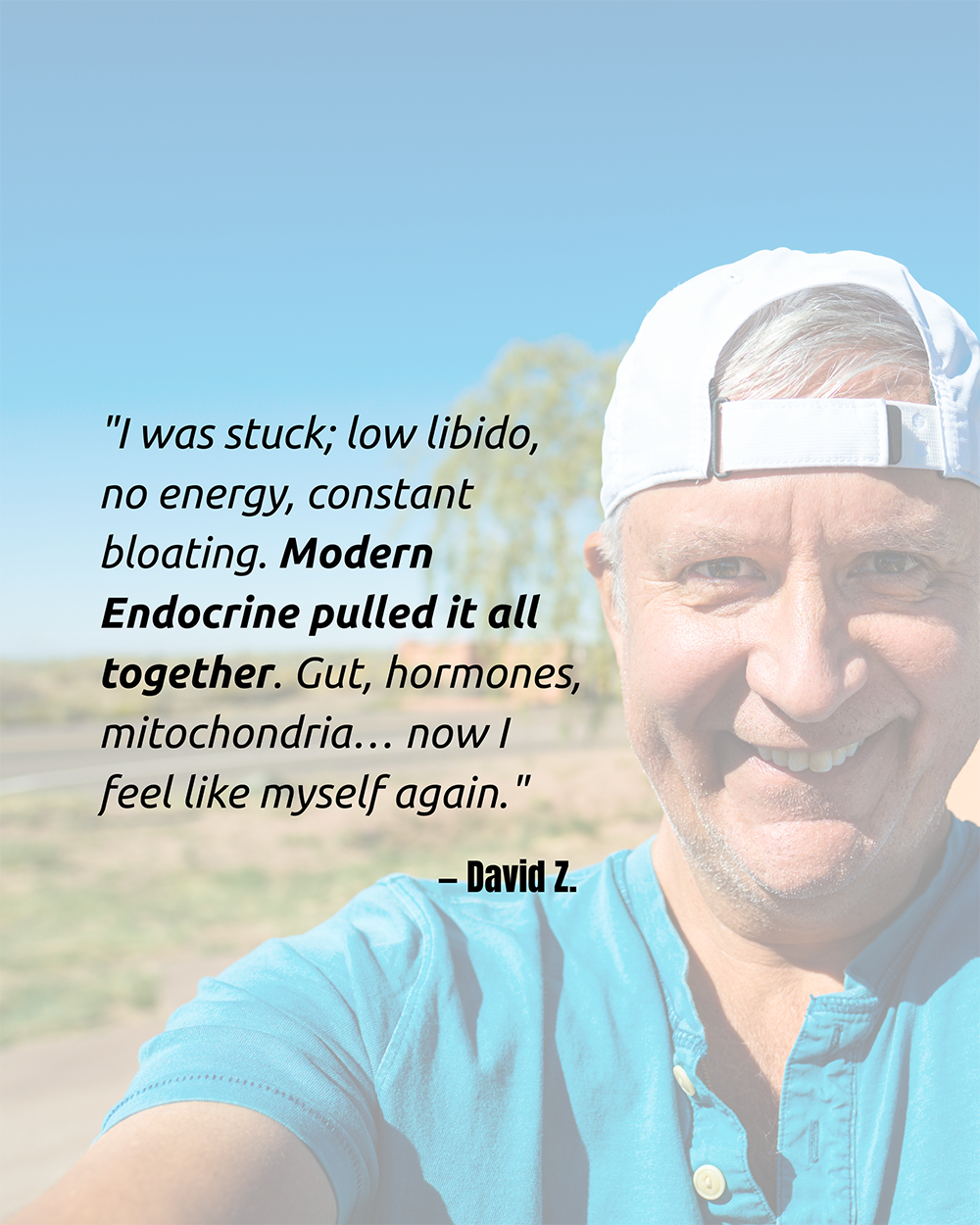
A 50-year-old executive came to me with low libido, brain fog, and relentless fatigue. He’d tried keto, intermittent fasting, and even a year of testosterone therapy—nothing stuck. His digestion was unpredictable, and he felt like he was “aging overnight.”
Our testing revealed three key issues: a disrupted microbiome, elevated evening cortisol, and sluggish mitochondria. His testosterone was borderline low, but hormones weren’t the whole story.
We rebuilt his plan from the ground up: gut repair with BPC-157 and targeted nutrients, cortisol regulation with adaptogens, mitochondrial support with NAD+ and CoQ10, and only then testosterone optimization.
Within four months, his bloating resolved, his energy stabilized, and his mental sharpness returned. He told me, “For the first time in a decade, I actually feel like myself again.”
That’s the power of treating systems, not symptoms.
Fuel Your Cells for Peak Performance with Cellular Renew
Even the best gut and hormone program won’t deliver if your cells are too weak to keep up. Cellular Renew provides a full-spectrum phosphatide blend designed to:
- Strengthen cell and mitochondrial membranes.
- Enhance communication between hormones and target tissues.
- Boost energy production at the cellular level.
- Support immune resilience and reduce inflammation.
When your cells are firing, your entire health reset works better—peptides hit harder, hormone therapy stabilizes faster, and gut healing holds long-term.
Why Settle for Patchwork When You Can Reset?
Men don’t need another patchwork fix. They need a reset—a strategic, connected plan that addresses gut health, hormones, and mitochondria together.
Stop spinning your wheels with quick fixes. If you’re ready for a personalized men’s health reset that restores energy, sharpens focus, and rebuilds vitality from the inside out, book a consultation today.
References
Kelly, D. M., & Jones, T. H. (2013). Testosterone: A metabolic hormone in health and disease. Journal of Endocrinology, 217(3), R25–R45. https://doi.org/10.1530/JOE-12-0455
Li, J., Zhao, F., Wang, Y., Chen, J., Tao, J., Tian, G., Wu, S., Liu, W., Cui, Q., Geng, B., Zhang, W., & Bian, X. (2020). Gut microbiota and testosterone metabolism: A new frontier in metabolic diseases. Clinical Science, 134(10), 1197–1208. https://doi.org/10.1042/CS20200260
Park, S., Moon, J. Y., Kim, M. H., & Choi, Y. K. (2020). Clinical applications of BPC-157 in gut healing: A review of mechanisms. Journal of Clinical Gastroenterology, 54(2), 95–101. https://doi.org/10.1097/MCG.0000000000001245
Sayed, R. K. A., Moustafa, M. E., & Abd-Elhakim, Y. M. (2021). The role of peptides in mitochondrial function and their potential in metabolic syndrome therapy. Frontiers in Endocrinology, 12, 646394. https://doi.org/10.3389/fendo.2021.646394